
Digital trust building is how service businesses convert website visitors into paying customers, and it’s one of the most underleveraged competitive advantages in local and regional markets. Yet most service businesses carry trust signals that actively undermine the credibility they’re working to earn. Consider a hypothetical but common scenario: a plumber with 12 five-star reviews but a vague website and zero expert content loses the job to a competitor with 40 reviews and a clear, professional online presence, even if the first plumber is the better craftsman. Building credibility online is no longer optional; it’s the difference between getting the call and being scrolled past.
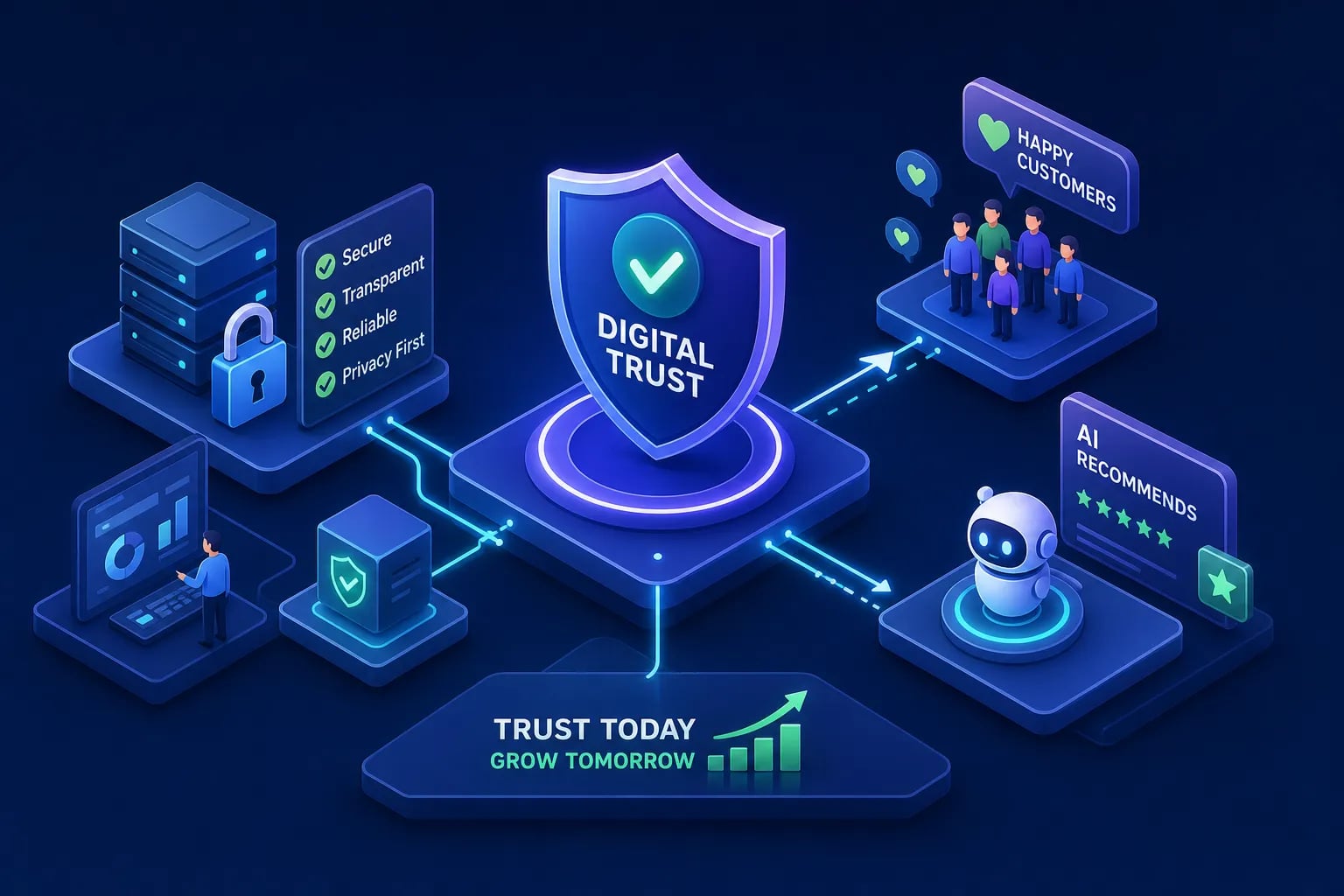
At TW3 Marketing, we consistently observe that trust gaps are costing service businesses leads they should be winning, a pattern we see play out across industries from HVAC and roofing to B2B professional services. This guide breaks down the core pillars, the practical tactics, and the signals you need to measure so you can close those gaps for good.
Why service businesses are losing the trust battle online
The trust gap customers feel before they ever call you
Many service business owners assume their reputation speaks for itself. Research tells a different story. According to McKinsey, 40% of consumers have taken their business elsewhere after a perceived trust violation, before a formal complaint is ever filed. For local service businesses, first impressions form fast: usability research consistently shows that visitors scan a homepage or Google Business Profile within seconds and make a credibility judgment almost immediately.
A trust gap looks like this in practice: inconsistent reviews spread across platforms, service pages that say nothing specific, no visible credentials or certifications, and content that hasn’t been updated in years. Visitors scan for reasons to feel confident. When those reasons aren’t there, they leave. The business that gave them a reason to stay gets the call.
How AI-driven search raised the digital trust bar
In 2026, a growing share of consumers, from homeowners scheduling repairs to B2B buyers vetting service vendors, are turning to AI assistants like ChatGPT and Google AI Overviews to find providers. Unlike traditional search, these systems often present concise, ranked recommendations rather than a full list of results to sort through. They evaluate which business appears most authoritative and trustworthy based on structured signals across the web, then surface one or two options with confidence.
A business with thin content, few reviews, and inconsistent NAP data simply won’t get recommended. Google AI Overviews pull from Google Business Profile data, structured website markup, review volume and recency, and cross-platform consistency. ChatGPT evaluates the quality and clarity of how a business is described across its website, directories, and mentions. Both systems look for the same core thing: clear, corroborated, consistent digital trust signals. If yours are weak, you’re invisible to the fastest-growing discovery channel in local search.
Digital trust building: the core pillars customers and AI both evaluate
What actually signals trustworthiness in a service business context
Credibility online is built on a small set of repeatable signals, and understanding why each one matters makes them easier to prioritize. Authentic social proof (reviews, testimonials, documented results), clear positioning that explains exactly who you serve and how, demonstrated expertise through content, and reliable engagement across platforms are the factors both human visitors and AI systems use to judge whether a business is worth recommending.
A strong signal looks like this: roughly 40 or more Google reviews posted over the past 12 months, each one responded to professionally, paired with a service page that explains the process, mentions certifications, and includes a short FAQ. A weak signal looks like this: a handful of reviews with no responses, a service page that says “quality workmanship at fair prices,” and a blog last updated years ago. The gap between those two businesses is not skill, it’s visible evidence of trustworthiness.
Why missing even one pillar undermines the others
Trust is evaluated holistically, not in silos. A business can have 80 five-star reviews but still fail the credibility test if its service descriptions are vague or its website content looks abandoned. If expert content is the missing piece, for example, AI systems may deprioritize an otherwise well-reviewed business because topical depth is one of the signals those systems use to verify expertise.
Think of it as a six-sided foundation, TW3 Marketing’s framework for authority: positioning, proof, expertise, visibility, engagement, and experience. Pull out one side and the whole structure becomes unstable. The goal isn’t perfection on every dimension; it’s being strong enough on all six that no single gap disqualifies you from the recommendation. These six sides map closely to the transparency, consistency, and competency pillars that trust researchers have identified as central to customer trust in digital services.
Authentic reviews: your most powerful digital trust signal
How to build a review strategy that actually works
BrightLocal’s 2026 Local Consumer Review Survey found that 97% of consumers read online reviews when evaluating local businesses, and 41% said they “always” read reviews before choosing a provider, up from 29% the year before. Reviews are the most visible, fast-acting credibility signal a service business has, yet most businesses treat review generation as an afterthought rather than a system.
A practical approach starts with timing. Ask at the moment of peak satisfaction, right after job completion, while the customer is still on-site or on the phone wrapping up. Use a simple direct link that takes them straight to the review form. Train your technicians and staff to make the request a normal part of closing every job. Volume and recency both matter: a smaller pool of recent reviews generally carries more weight than a larger pool from several years ago, because recency signals to AI systems that the business is still active and still earning trust.
Responding to reviews as a credibility multiplier
How a business responds to reviews tells prospective customers more than the star rating alone. A professional, calm response to a one-star review signals accountability and customer care in a way that five-star reviews simply can’t. A practical response framework: acknowledge the concern directly, state what you did or will do, and invite offline resolution. Keep it short and professional.
Response rate and tone are also trustworthiness metrics that AI systems interpret when assessing business credibility. A business that responds consistently to its reviews, including the negative ones, looks more engaged and accountable than one with a higher average rating but zero responses. That engagement signals an active, customer-focused operation, and that matters to both the next human reader and the AI system deciding who to recommend. Aim to respond to as high a percentage of reviews as possible; the habit itself reinforces your digital trust signals over time.
Expert content and service descriptions that do the selling for you
Why vague service pages are costing you conversions
“We offer quality HVAC services” is not a service description. It’s a placeholder. Service pages that lack specifics give visitors no reason to trust that you know what you’re doing. A high-converting, trust-building service page includes a clear scope of what’s involved, process transparency (what happens when you call, what the visit looks like, what the timeline is), any relevant credentials or certifications, and a short FAQ that addresses the objections customers actually have: How much does it cost? How long does it take? Do you pull permits? What’s your warranty?
Specific service pages also convert better because they reduce friction. When a visitor can read exactly what to expect and see evidence that you’ve done it before, the decision to contact you becomes much easier. Vague pages force visitors to take a leap of faith, and most of them won’t.
Publishing expert content that signals authority to humans and AI
Expert content doesn’t mean academic writing. It means publishing articles, guides, or videos that answer the real questions your customers are asking before they hire anyone. An HVAC company that publishes a guide on “how to know when your AC unit needs replacement vs. repair” positions itself as the expert in that decision, not just another option on a results page. A roofing contractor that explains the difference between repair and full replacement, with honest cost ranges, builds data privacy trust and professional credibility before the first phone call.
This type of content also directly improves AI recommendation likelihood. Both Google AI Overviews and ChatGPT look for topical depth and demonstrated expertise when deciding which businesses to surface. A website with 10 well-written, specific articles on HVAC topics looks meaningfully different to an AI system than a website with five vague service pages and no supporting content, and topical authority is what moves you from invisible to recommended.
Consistent brand messaging across every digital platform
What brand consistency actually means for a service business
Brand consistency isn’t about having a matching logo everywhere. It’s about whether your business communicates the same value proposition, tone, and expertise across your website, Google Business Profile, social media, and directory listings. Inconsistency erodes trust fast: different phone numbers, mismatched service descriptions, or a Facebook page that hasn’t been updated in two years all signal to visitors and AI systems alike that the business may not be active, reliable, or credible.
An NAP and messaging audit covers five areas: phone number and address consistency across all platforms, service descriptions that match what’s on your website, business category alignment in Google Business Profile and key directories, profile completeness (hours, photos, attributes), and content recency. Inconsistent NAP data can also prevent search engines from confidently linking your citations and reviews to one verified entity, which directly weakens your local search visibility.
Aligning your digital presence to reinforce trust signals
Once each platform is consistent, the combined effect creates what buyers and AI systems read as authority. A business that clearly communicates the same strengths across five or more digital touchpoints is one that both audiences read as established and reliable. Each consistent data point is another confirmation for an AI system that this business is exactly what it claims to be.
Think of it as digital footprint alignment. Your reviews, your content, your service pages, your business profiles, and your social presence either reinforce each other or work against each other. When they’re aligned, each signal amplifies the others. When they’re inconsistent, no single signal is strong enough to overcome the doubt that inconsistency creates.
Measuring your trust signals and closing the gaps for good
The KPIs that actually reflect credibility, not just traffic
Most service businesses measure marketing performance with metrics like website visits and ad clicks. Those numbers don’t tell you whether your digital trust signals are working. The KPIs that actually reflect credibility improvement include review volume and recency trends, average rating and response rate, website conversion rate (visitors to contact form or call), branded search volume growth, and content engagement on expert articles.
Connect each trust signal to the outcome metric it should move. Strong reviews should improve your click-to-call rate and contact form submissions. Better service pages should reduce bounce rate and increase time on page. Published expert content should grow branded searches and organic traffic over time. Tracking these together gives you a clear picture of which signals are performing and where the gaps are costing you leads, a practical application of trust management that goes beyond surface metrics.
How TW3 Marketing’s Authority Audit™ identifies exactly where your trust breaks down
Closing trust gaps requires knowing where they are. TW3 Marketing’s Authority Audit™ is a proprietary 100-point diagnostic designed to measure six core digital trust pillars across a business’s digital presence: positioning, proof, expertise, visibility, engagement, and experience. Rather than guessing which signals to fix first, the audit gives service businesses a scored baseline and a prioritized action plan built around the specific signals that matter most for AI recommendation and customer conversion.
TW3 Marketing’s Authority Score™ Check is designed to show how a business appears in both Google and ChatGPT, giving you a concrete starting point for any digital trust building effort. Instead of working through a generic checklist, you see exactly where you stand and what to fix first, clarity that separates businesses that make meaningful progress from those that keep investing in tactics without understanding the underlying problem.
Build digital trust systematically, or keep losing leads to competitors who do
Digital trust building isn’t a one-time project. It’s an ongoing discipline that compounds over time. Each review you earn, each expert article you publish, and each service page you sharpen adds another layer of credibility that both customers and AI systems can recognize and reward. Research on AI-driven search consistently points to the same conclusion: the businesses that get recommended aren’t necessarily the ones with the biggest ad budgets, they’re the ones with the clearest, most consistent, and most believable authority signals across every digital touchpoint.
Start by auditing what you currently have. Identify your weakest signal, and fix that first. A business that responds to every review this month, rewrites two service pages this quarter, and publishes one expert article every six weeks is building something that compounds. A business that keeps running ads without fixing the trust signals underneath is pouring water into a leaky bucket.
If you want a structured starting point for finding those gaps, TW3 Marketing’s Authority Audit™ gives you a scored roadmap so you know exactly where to focus. The businesses that take that first step are the ones that start showing up where it matters: in AI recommendations, in Google results, and in the inbox of customers who were ready to hire before they even made the call.
