
When local service business owners ask what a marketing audit should include, the answer usually surprises them. Most assume their marketing problem is a tactics problem, not enough ads, not enough content, not enough channels. But adding tactics on top of a broken foundation doesn’t fix anything. It just burns money faster. Many local service businesses under-invest in diagnostics before scaling channels, which is why audits matter more than most owners realize.
The real issue is that a significant number of businesses skip the audit entirely. They invest in campaigns before they know whether their Google Business Profile is accurate, whether their tracking actually captures leads, or whether 25 percent of their inbound inquiries are going unanswered. The symptoms look like bad marketing. The cause is broken authority signals underneath.
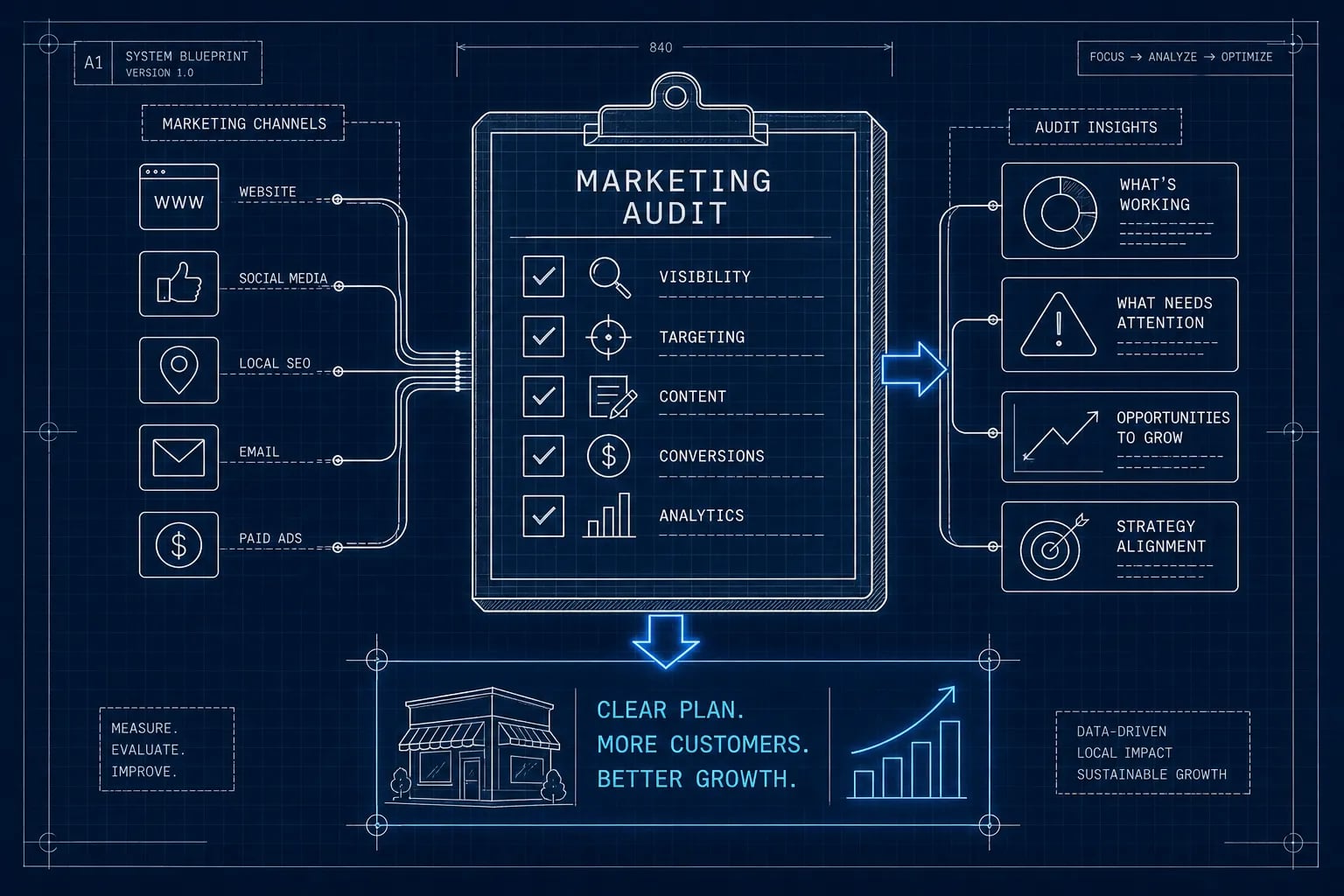
This article answers exactly what a marketing audit should include for a local service business, organized around six signals that determine whether you earn leads or lose them: positioning, proof, expertise, visibility, engagement, and experience. These are the same six signals that power TW3 Marketing’s 100-point Authority Audit™, which aligns with the authority signals used by today’s AI-driven search systems when deciding which businesses to recommend. Work through each section, note your gaps, and use the prioritization method at the end to sequence your fixes.
Why Most Local Service Marketing Fails Before It Starts
The six authority signals are not abstract. They describe the practical gaps that keep a good service business invisible, untrustworthy, or unconvertible online. Positioning answers whether a visitor immediately understands what you do, who you serve, and where. Proof covers whether visible evidence of your work and results exists. Expertise signals whether your content and presence indicate deep knowledge of your trade.
Visibility determines whether people can find you across platforms. Engagement measures whether people respond, interact, and whether your business responds back quickly. Experience covers whether the process of contacting and hiring you is smooth or frustrating.
Most businesses are weak in two or three of these areas. The audit exists to find which ones. TW3 Marketing’s 100-point Authority Audit™ scores all six signals across a business’s full digital presence. The consistent finding across clients is that trust is leaking somewhere specific, not everywhere at once, and fixing the right signal produces compounding results.
What Should a Marketing Audit Include for a Local Service Business, Visibility & GBP
Before conversion and follow-up matter, you need to confirm the business is showing up where buyers are looking. Visibility is the most auditable signal, and the Google Business Profile is the first place to check. This is also the core of any local SEO audit worth running.
Google Business Profile Diagnostic Checklist
Start with the basics: is the profile claimed, verified, and fully filled out? That means accurate primary category, secondary categories, services listed, business description, hours including special hours, NAP details that match your website exactly, and no duplicate or suspended listings. Then look at photos and reviews. According to BrightLocal’s 2026 local search analysis, complete profiles earn roughly seven times more clicks than incomplete ones, and profiles updated regularly see five times more views. That’s not a marginal difference.
Once the basics are confirmed, benchmark the top three competitors in your local pack. Compare their category depth, review velocity over the last 30 days, and photo recency. This tells you where the highest-impact gaps are in your specific market, not against a national average that may not apply.
Local Citations, NAP Consistency, and Directory Accuracy
Build one master NAP record: the exact business name, address format, phone number, and website URL you want everywhere. Then check Yelp, Bing Places, Apple Maps, Facebook, and any niche directories relevant to your trade. Inconsistencies confuse search engines and AI systems trying to verify your entity, and the fix is simpler than most businesses expect. For any business that has changed addresses, phone numbers, or operating hours in the past two years, a quarterly re-audit is worth scheduling. This citation consistency check is a non-negotiable part of any marketing audit checklist for local businesses.
Proof and Trust Audit: Does Your Business Look Credible Online?
Proof and experience are the two authority signals most directly tied to whether a visitor converts. This section audits the signals that build or break trust before a prospect ever contacts you, including the signals AI systems weigh when deciding which businesses to surface in recommendations.
Review Volume, Recency, and Response Rate Benchmarks
Strong review health means more than a high average rating. Check review volume relative to your top competitors, recency (reviews in the last 30 days carry more weight than old volume), response rate, and whether the rating has been stable or declining. A thin review profile is not a reputation problem; it’s a process problem. The fix is a consistent review request tied to job completion, not a one-time push.
Website Trust Signals That Convert Visitors and Satisfy AI Systems
A credible service business website needs a clear service area statement, visible certifications and licenses, project photos or case studies, a guarantee or satisfaction statement, and a clickable phone number above the fold. These are functional trust requirements, not design choices. A website that looks credible to a visitor also looks credible to AI. Google AI Overviews and ChatGPT both use structured authority signals when deciding which businesses to include in generated answers. A site that buries its service area, hides its credentials, and lacks proof content is harder for AI systems to trust and recommend, regardless of how much you spend on ads.
What Should a Marketing Audit Include for a Local Service Business, Tracking and Conversion
Most service businesses are partially flying blind. Analytics is installed but misconfigured. Calls aren’t tracked by source. Forms fire but don’t connect to campaigns. None of this is obvious until you audit it specifically. A thorough marketing performance audit for contractors and service firms starts here.
Analytics, UTM, and Call Tracking Verification
Pull 90 days of data from your analytics platform, CRM, and ad platforms side by side. Check whether the lead counts agree, if they don’t, tracking is broken somewhere. Convert the core verification steps into a working checklist:
- GA4 events matching actual lead actions rather than just pageviews
- Call tracking numbers swapping correctly by source
- UTM naming conventions consistent across all campaigns
- Form submissions firing conversion tags
A source-to-sale reconciliation test, tracing a sample of real leads backward from the CRM to the original campaign, will surface gaps faster than any report.
Website Conversion Benchmarks for Service Industries
Local service websites typically convert between 2 and 5 percent of visitors into leads. Well-optimized pages reach 5 to 8 percent. High-intent emergency pages, particularly for plumbing and HVAC, can exceed 10 percent, and dedicated paid landing pages in those trades sometimes reach 12 to 16 percent. These are comparison points, not pass/fail thresholds. Traffic quality and source affect results significantly, so the more useful question is whether your conversion rate is improving over time and whether it’s competitive against your own historical baseline.
Lead Follow-Up and Ad Spend Audit: Where Money Quietly Leaks
Two of the biggest waste sources for service businesses are invisible unless you look for them: leads that fall through after inquiry, and paid campaigns running on autopilot. Engagement is a two-way signal. It measures whether the business responds, and whether its paid media attracts the right people.
CRM and Lead Handling Diagnostic
Check whether every lead channel, including calls, forms, chat, and booking, flows into one documented system. Verify that each lead is tagged by source, service, and status. Then measure response speed, missed call rate, follow-up sequences, and close rate by channel.
A common audit finding is that 20 to 30 percent of inbound leads are never followed up on. TW3 Marketing’s audit data consistently shows HVAC businesses responding within one hour close leads at 44 percent, versus 12 percent for those responding after four hours. For plumbing, that gap runs 51 percent versus 18 percent. Speed of response is not a customer service issue. It’s a revenue issue. That’s an operational fix with a direct impact on marketing ROI, and it doesn’t cost anything to improve.
Common Ad Spend Inefficiencies for Local Service Businesses
The most frequent Google Ads leaks are broad match keywords pulling irrelevant search terms, missing negative keywords (especially job-seeker and DIY queries), and location targeting set to “presence or interest” instead of “presence only.” Those three fixes alone often recover 15 to 25 percent of wasted spend. Facebook Ads waste most commonly comes from audiences too wide for a local service radius and creative that doesn’t pre-qualify the caller. If your ads don’t mention your service area, a pricing cue, or a clear next step, you’re paying for curiosity, not calls.
How to Prioritize Audit Findings and Build Your Action Plan
An audit that produces a list of problems without a prioritized plan is just a document. Most business owners stall here, so a simple scoring method helps move findings into action.
A Simple Scoring System for Ranking Your Fixes
Score each finding across four variables: impact (how much does fixing this affect lead volume or revenue?), effort (how long will this take?), confidence (how certain are you this is the root cause?), and ownership (who is actually responsible for fixing it?). Sort by highest-impact, lowest-effort items first. Organize fixes into a 30-60-90 day plan with review checkpoints so progress is measurable rather than aspirational.
When to Run the Audit Yourself and When to Bring In a Specialist
Most service business owners can run the visibility, proof, and lead follow-up checks using this article. The GBP review, citation consistency, website trust signals, and CRM response rate checks are all accessible without technical help. Tracking setup, attribution logic, and AI discoverability signals are where specialist input tends to pay off, errors there quietly distort every decision downstream.
TW3 Marketing’s Authority Score™ Check shows how a business currently appears in Google and ChatGPT, giving owners a scored baseline without committing to a full engagement. It maps your six authority signals against what AI-driven search systems actually surface, a fast way to know where you stand before deciding how much to invest in fixes.
Run the Audit Before You Invest Another Dollar
Understanding what a marketing audit should include for a local service business comes down to one principle: stop the leaks before you add more water. The six authority signals, positioning, proof, expertise, visibility, engagement, and experience, give the audit structure and make findings comparable over time. Without that structure, you’re guessing.
The businesses winning in local search and AI recommendations right now are not necessarily spending more. They’ve closed their trust gaps. Their GBP is complete. Their reviews are recent and responded to. Their tracking connects to revenue. Their leads get called back within minutes. These are not complicated fixes. They’re just uncommonly executed, and a structured marketing audit checklist for local businesses is what separates the businesses that know from the businesses that assume.
Start with the GBP and review checks this week. Work through tracking and conversion in the next 30 days. If you want a scored baseline rather than a DIY pass, TW3 Marketing’s Authority Audit™ was built specifically for this, it shows you exactly which signals are costing you recommendations before you invest another dollar in campaigns that can’t convert.
