
Your business authority score comes back as 18 when you enter your website into Semrush or Moz. Should you worry, or does that number fall within the normal range? If you’ve ever wondered what an authority score means for your business and what it actually measures, you’re not alone. Most SEO tools fail to give business owners a clear answer. This article explains both the standard SEO definition and the broader AI-era trust signals that matter just as much in 2026. By the end, you’ll know which score to target, how to check yours for free today, and what steps to take over the next 90 days to improve it.
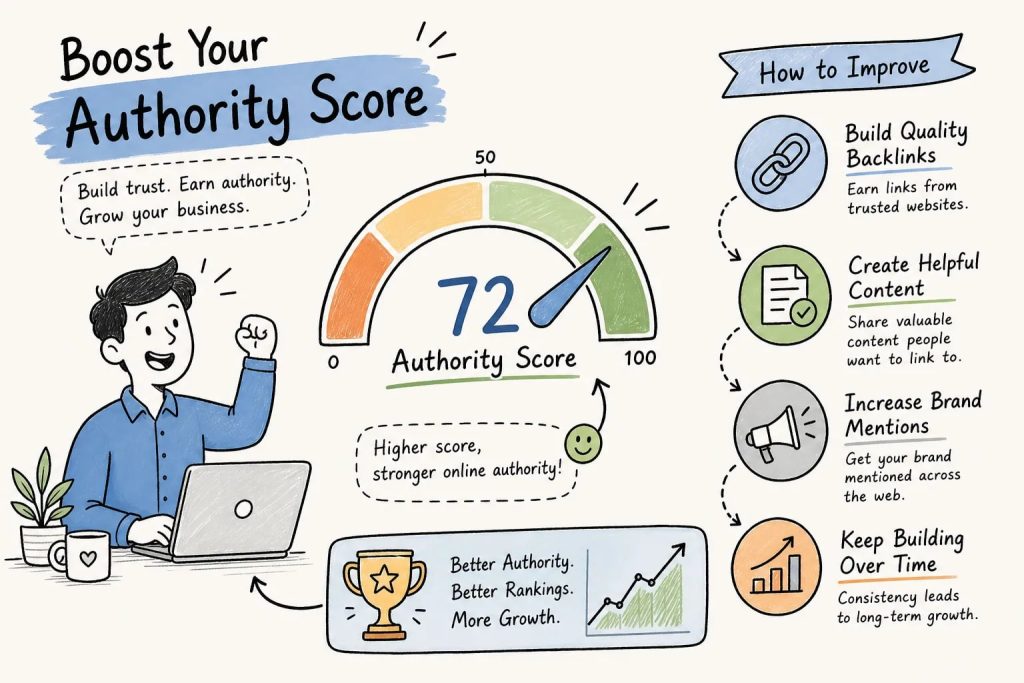
The short version: your business authority score is not one single number, and no tool has the full picture. The longer version is worth understanding, because getting this wrong means either panicking over a healthy score or ignoring a real gap that’s costing you customers.
What Is an Authority Score for a Business?
Moz, Semrush, and Ahrefs each produce a 0, 100 score designed to estimate how strong a website’s presence is in organic search. These are independent metrics based on each tool’s own data crawl. Google does not publish a domain authority number, and none of these scores come from Google directly. They’re estimates, useful ones, but they’re built from different ingredients.
The bigger issue in 2026 is what these scores leave out. When a homeowner asks ChatGPT “who’s the best HVAC company near me,” the AI doesn’t consult Semrush. It evaluates trust signals: how clearly a business communicates what it does, what third-party sources say about it, whether its expertise is documented and machine-readable, and how consistently it appears across the web. Research into how large language models retrieve and surface businesses suggests that entity clarity, structured data, and third-party corroboration carry significant weight in AI-generated recommendations, signals that don’t show up cleanly in a Moz or Semrush score.
A business can have a Semrush Authority Score of 35 and still be invisible in ChatGPT answers. Another business with a score of 17 may show up in AI recommendations because its positioning, reviews, and structured data are dialed in. You need both lenses to know where you actually stand.
How Moz, Semrush, and Ahrefs Calculate Their Scores Differently
Moz Domain Authority is the most explicitly predictive of the three metrics. It uses machine learning trained on real ranking outcomes in Google, not just raw backlink counts. That makes it useful for competitive benchmarking, but it’s not a direct measure of credibility or trust. Think of it as a ranking-potential estimate rather than a credibility score.
Semrush Authority Score is the most composite authority score metric. It blends backlink data, organic search traffic, and anti-spam signals into a single number. Because Semrush incorporates spam and link-quality signals into its composite score, sites with unnatural or low-quality link profiles can score noticeably lower in Semrush than in Ahrefs. Scores update monthly.
Ahrefs Domain Rating is the most link-focused of the three. It measures the quantity and quality of backlinks pointing to a domain and does not factor in organic traffic or spam signals at all. That makes it a strong tool for evaluating backlink authority and link-building opportunities, but it provides the least complete picture of overall authority. The key takeaway: the same site will often score differently across all three tools. Never treat one number as gospel, and never make decisions based on a single metric.
What Score to Target Based on Your Business Type
For local service businesses, HVAC, plumbing, roofing, insurance, general contracting, a score between 10 and 35 is normal and often more than competitive. Many local businesses in this range outrank larger brands in their market because local relevance, Google Business Profile completeness, consistent citations, and review volume carry significant weight. A score of 18 for a plumber competing in a mid-sized U.S. metro is not a disaster. It’s a starting point.
Established regional or multi-location businesses typically sit in the 35, 50 range. National businesses competing across broader keyword sets generally need 50, 60 or higher to hold strong positions. Very large publishers and recognized national brands often exceed 60, but that ceiling is rarely relevant for the service businesses most likely reading this article.
The most useful benchmark is not a number from a chart, it’s your direct competitors’ scores in your actual market. If the top three HVAC companies in your city average a score of 22, a score of 18 is a four-point gap, not a structural problem. Pull competitor scores in Semrush or Ahrefs before deciding how urgently your number needs attention. The gap is what matters, not the absolute score.
The Six Signals That Determine Real Authority in the AI Era
Traditional SEO authority scores measure backlinks and traffic. AI systems like ChatGPT and Google AI Overviews evaluate a richer set of signals before deciding which business to recommend. TW3 Marketing’s Authority Framework™ identifies six core components that drive both customer trust and AI discoverability, developed through extensive work across service industries.
Positioning and proof are commonly the weakest links. Positioning is how clearly a business communicates who it serves and what it delivers. Proof is the verified evidence that backs those claims: reviews, case studies, awards, published client outcomes. Weak positioning and thin proof are frequent contributors to poor AI discoverability, even when SEO scores look reasonable.
Expertise and website authority work together. Expertise signals include published content, thought leadership, citations in relevant publications, and structured data that helps AI systems understand what a business knows. Website authority refers to how consistently a business appears across the platforms, directories, and data sources that AI assistants query. A business can have deep real-world expertise and still be invisible if that expertise isn’t formatted for machine readability.
Engagement and experience round out the picture. Engagement covers how audiences interact with a business online: review response patterns, social proof, and content interaction signals. Experience signals come from the on-site and off-site journey: page usability, load speed, review sentiment, and whether customers report positive outcomes. Here’s a simple way to think about it: positioning gets you matched. Proof gets you validated. Expertise gets you qualified. Visibility gets you noticed. Engagement gets you reinforced. Experience gets you believed.
How to Check Your Authority Score Right Now
For an SEO baseline, three free tools cover the ground. Semrush’s free Website Authority Checker gives you an Authority Score. Moz’s free Domain Authority Checker gives you DA and Page Authority. Ahrefs’ free Website Authority Checker gives you Domain Rating. Running all three typically takes under ten minutes and gives you a realistic range rather than dependence on any single tool’s methodology. Use all three, compare the range, and check competitors at the same time.
For businesses that want to know how they actually appear inside Google and ChatGPT, not just their backlink strength, TW3 Marketing’s Authority Score™ Check offers a diagnostic assessment built around the six core authority signals. It evaluates positioning, proof, expertise, visibility, engagement, and experience in a single review, showing exactly where the gaps are between a business’s current standing and what AI systems need to recommend it. That’s a fundamentally different analysis than what Semrush or Moz produce.
Monthly monitoring is a practical cadence for most small businesses. Semrush updates its Authority Score monthly. Ahrefs crawls more frequently. The more useful habit is pairing your monthly score check with a competitor comparison: watching whether the gap between your score and your competitors’ scores is closing or widening matters far more than any single absolute number.
A 90-Day Plan to Raise Your Authority Score for Your Business
In the first 30 days, focus on fixing what already exists. Audit and remove toxic backlinks, fix technical issues that suppress crawlability, claim and optimize all business directory listings for citation consistency, and make sure your Google Business Profile is complete and accurate. These steps improve Semrush Authority Score directly, because the tool penalizes spam signals, and they also improve the AI-readability of your site. Fast, foundational, and often overlooked.
Days 31 through 60 shift to earning quality backlinks and publishing authority content. Target three to five genuinely authoritative backlinks per month through local press, industry directories, guest contributions, and partner pages. Simultaneously, publish content structured around specific expertise: service explainers, FAQs, and case studies that demonstrate depth. Consistent link building at this pace can move a score five to ten points within three to six months for most small businesses, a realistic expectation based on observed patterns in authority-building campaigns, though results will vary by industry and starting point.
In the final stretch, days 61 through 90, audit how your business appears in ChatGPT and Google AI Overviews by running targeted test queries relevant to your services and location. Strengthen proof signals by collecting new reviews, publishing outcome-based content, and adding structured data markup. Then review score movement across Semrush, Moz, and Ahrefs against your competitors. One important reality check: scores increase more slowly as they climb. Each next ten-point jump typically requires two to three times more effort than the previous one. Celebrate early wins and stay consistent rather than chasing shortcuts that don’t exist.
Know Your Score Before You Spend Another Dollar on Marketing
Understanding what is an authority score for a business now means understanding two separate definitions, and you need both. The SEO tool metric, built on backlinks, traffic, and spam signals, tells you how you compare in traditional search. The AI-era trust framework, built on positioning, proof, expertise, visibility, engagement, and experience, influences the likelihood that AI systems will surface your business when customers ask ChatGPT or Google who to call. Most businesses are only measuring one of the two.
Your target score depends on your local competition, not a generic benchmark. If your competitors average 22, you don’t need 60. You need 25 and better proof signals than they have. That’s a winnable gap, and it’s a much more useful frame than chasing an arbitrary number.
Start with the free SEO tools today to get your baseline score across Semrush, Moz, and Ahrefs. Then use TW3 Marketing’s Authority Score™ Check to see the full picture, including how your business actually appears inside AI systems like ChatGPT and Google AI. That’s where knowing your authority score for your business stops being a data point and becomes a specific, actionable plan.
