
If you’ve ever searched “what is a good authority score for small service business and how do I improve it,” you’ve probably already checked your Moz DA or SEMrush Authority Score at least once, and walked away with one of two feelings: falsely reassured because the number looked fine, or unnecessarily panicked because it looked low. Neither reaction is useful without a benchmark. The number means nothing in isolation.
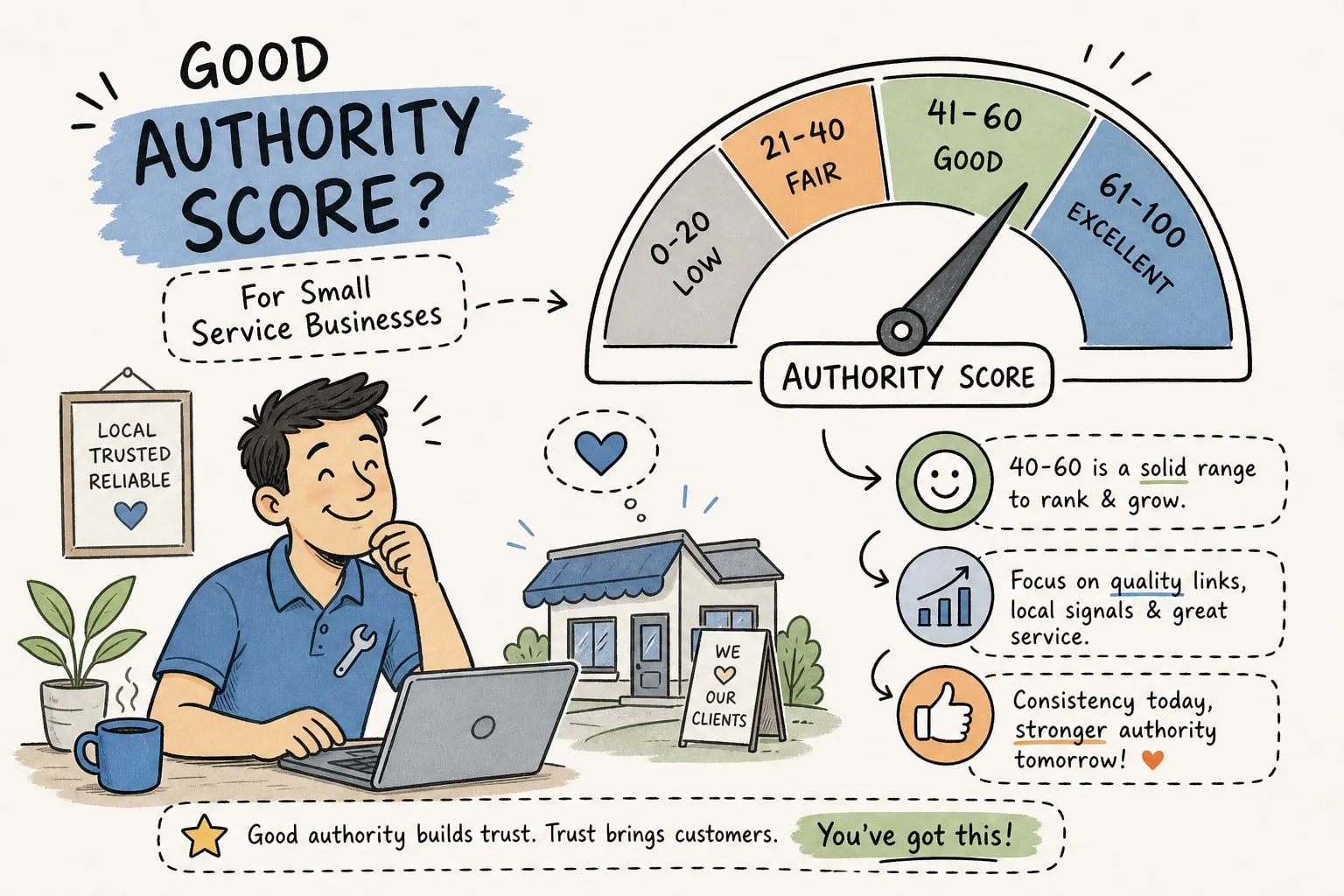
Here’s what this article gives you: a realistic target for a local service business competing in the United States, a plain-language breakdown of how the major authority tools compare, and a concrete six-step plan to move your score in the right direction. There’s also a layer most DA guides skip entirely: in 2026, authority signals aren’t just influencing Google rankings. They’re feeding AI platforms like ChatGPT and Google AI Overviews, which are now the starting point for a growing share of searches for contractors, HVAC companies, and service providers. That’s what makes this worth your attention.
What Is a Good Authority Score for a Small Service Business?
Before benchmarks make sense, you need to understand what these scores are actually calculating. A score of 22 in SEMrush and a score of 22 in Moz are not the same thing. They don’t measure identical signals, and they don’t use the same underlying data.
Moz Domain Authority, Ahrefs Domain Rating, and SEMrush Authority Score are all predictive metrics. They estimate how likely a domain is to rank competitively based on the strength and volume of its backlink profile. None of them is an official Google metric. They’re third-party approximations built on different crawlers, different link databases, and different formulas. Treat them as directional indicators, not report cards.
Because each platform uses its own crawler, link database, and formula, there is no dependable one-to-one conversion between Moz DA, Ahrefs DR, and Semrush Authority Score. Pick one tool, track your trend consistently, and compare your site with local competitors using the same metric.
Realistic Benchmarks: What Score Should a Local Service Business Actually Aim For?
A good authority score is one that is competitive with the businesses already visible for your priority services in your actual market. There is no universal score that guarantees rankings. Compare your domain with the top relevant local competitors, review the quality of the sites linking to each business, and use the gap as a directional benchmark rather than a pass-or-fail grade.
Why Authority Signals Now Matter for AI Recommendations, Not Just Google Rankings
This is where most domain authority guides stop short. In 2026, your authority signals aren’t only influencing where you appear in traditional search results. They’re determining whether AI platforms recommend you at all. Google AI Overviews and ChatGPT are now the starting point for a growing share of “find me a contractor near me” searches, and they use a broader set of signals than a backlink count.
AI recommendation systems evaluate trust across multiple dimensions: how consistently your business is mentioned across authoritative sources, whether your expertise is clearly established through your content, how strong your reviews and reputation signals are, and whether your service area and positioning are specific and clear. A business with DA 30 but thin content, weak reviews, and inconsistent citations can still be completely invisible inside AI search results. The backlink profile is one input, not the whole picture.
This gap between third-party authority scores and real buyer visibility is what the TW3 Marketing Authority Audit is designed to examine. The free assessment reviews the broader signals that help a service business look clear, credible, and easy to verify across search and AI-assisted discovery.
How Do I Improve My Authority Score? The Backlinks That Actually Move the Needle
Generic advice tells you to “build backlinks.” That’s not useful. What actually moves the score for a local service business is a specific type of link from a specific type of source, and the distinction matters more than the volume.
The links most likely to strengthen a local service business come from relevant, legitimate sources that reflect real relationships and community presence. Prioritize quality, relevance, and editorial trust over a fixed link count:
- Chamber of Commerce and trade association listings: highest quality, locally trusted, and harder to get than a basic citation
- Local sponsorship pages from events, nonprofits, and school programs: high quality, genuine editorial placement with real local relevance
- Partner, supplier, and vendor links from real business relationships: very strong because credibility is earned through association
- Community and neighborhood organization pages: medium to high quality when the organization is active and locally trusted
- Local citations and directories: useful as a foundation for local SEO authority and NAP consistency, but the lowest-value individual backlinks of the group
Build these links steadily through genuine partnerships, useful resources, professional memberships, and community participation. Avoid buying bulk links or treating an arbitrary referring-domain count as a guarantee.
A 6-Step Action Plan to Raise Your Authority Score
This plan is built around what actually works for local service businesses based on how authority scores respond to real-world link acquisition and content strategy. The steps are sequential. Don’t skip to step four before you’ve completed step one.
Steps 1-3: Build the Foundation
Step 1: Audit and fix your local citations. Before building new links, lock down NAP consistency across the top directories. Inconsistent business name, address, or phone number across listings actively dilutes your local authority signals. Google Business Profile, Apple Business Connect, Yelp, BBB, and Angi are the non-negotiables for home services and contractor businesses. Fix the inconsistencies first.
Step 2: Claim and optimize your Chamber of Commerce and trade association listings. These are the highest-quality local links most service businesses already have access to and haven’t claimed. A chamber membership with no listing is a missed opportunity. Get it claimed, fill it out completely, and make sure the link points to your website.
Step 3: Launch a service-area content strategy. Publish detailed, expert-level content that covers the specific problems your customers search for. This content serves two functions: it gives Google and AI platforms clear signals about your expertise, and it creates something worth linking to. Thin service pages and generic “About Us” copy don’t move authority scores. Useful, specific content does.
Steps 4-6: Build Authority and Accelerate
Step 4: Build partner and supplier links through existing relationships. Reach out to the vendors you buy from, the manufacturers whose products you install, and the referral partners you already send business to. Ask for a mutual mention. These links are relationship-based, which makes them credible. They also take one email, not a months-long outreach campaign.
Step 5: Pursue local sponsorship opportunities regularly, roughly one per quarter as capacity allows. Events, youth sports teams, nonprofits, and school fundraisers often have sponsor pages on their websites. These are legitimate, locally relevant backlinks that cost far less than a traditional ad spend and carry more authority signal weight than most business owners realize.
Step 6: Systematize review generation. Reviews are a conversion signal and an AI trust signal simultaneously. A consistent, simple follow-up process, a text or email after every completed job, compounds fast. Businesses with strong, recent review profiles are both more likely to convert new leads and more likely to be recommended by AI platforms evaluating which local contractors to surface.
How Long Before You See Measurable Results?
Authority growth is gradual. New links must be discovered, content must earn engagement, and local citations must remain consistent before trends become meaningful. Review the same third-party metric at regular intervals, but judge progress over months and alongside qualified traffic, visibility, leads, and conversions.
Where to Go from Here
A useful authority score is relative to the competitors and queries that matter in your market. The six-step plan above strengthens the underlying trust and visibility signals instead of chasing a universal number.
The more important realization is that authority score is no longer just a Google metric. It’s feeding the AI recommendation systems your customers are already using to find contractors, HVAC companies, and service providers. Traditional backlink building and local SEO authority optimization are increasingly part of the same strategy, and treating them separately leaves real visibility on the table.
Start with the citation audit, lock down your foundation, and build from there. If you want a broader view before investing more in marketing, begin with the free TW3 Marketing Authority Audit.
