
If you’re wondering how to build online credibility for a local contractor business, start by accepting a hard truth: homeowners making a $10,000 decision can’t evaluate your craftsmanship from a search results page. Research consistently shows that online credibility is a leading factor in homeowner hiring decisions, contractors who appear more credible online win jobs even when competitors do comparable work. The real game is being played entirely on digital signals before anyone picks up the phone.
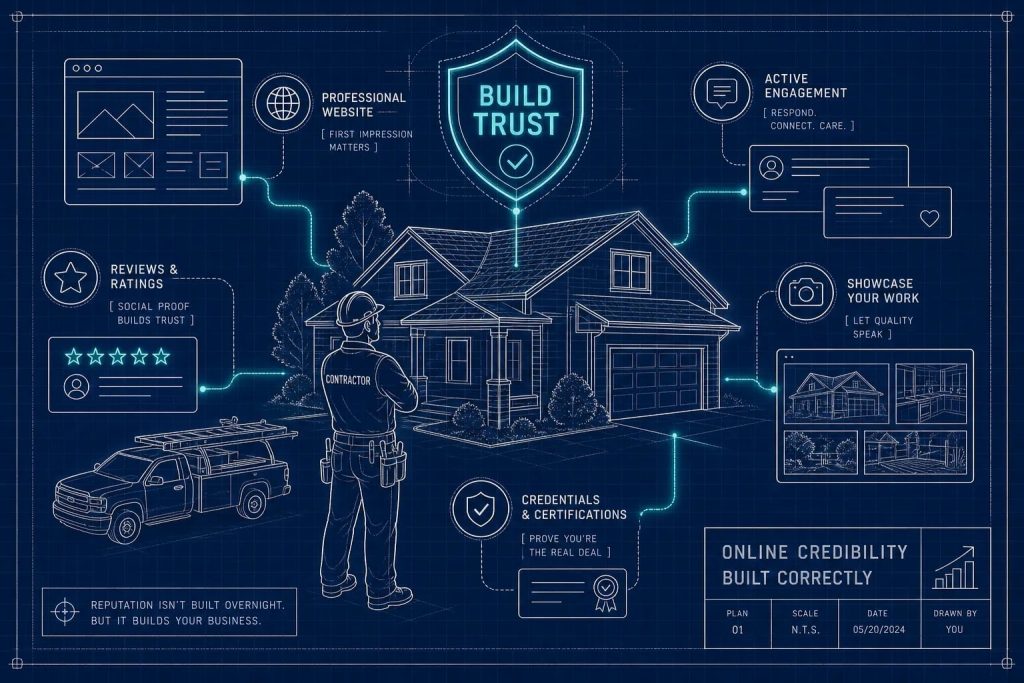
Online credibility isn’t about looking polished or running a slick ad. It’s about removing the doubt that makes someone click away. The moment a homeowner feels uncertain, who you are, whether you’re licensed, whether past customers were happy, that hesitation costs you the job. Someone else captures it instead.
The five areas below are where contractor can build online credibility actually lives. Work through them in order. Each one builds on the last, and skipping ahead wastes effort you don’t have to waste.
Find your credibility gaps before you start fixing things
Most contractors jump straight into tactics. They add a few photos, ask a couple of customers for reviews, then wonder why nothing changes. The problem usually isn’t what they’re doing. It’s what they don’t know they’re missing. Credibility gaps are often invisible from the inside.
Without a baseline, you optimize the wrong things first. A contractor might spend weeks redesigning their website when the actual problem is zero reviews on their Google Business Profile, or a licensing credential buried three pages deep that nobody ever sees. A redesign rarely moves conversion numbers when the real trust gap was never in the design to begin with.
Homeowners evaluate a contractor using six signals, often unconsciously: recent reviews and star rating, real project photos, visible license and insurance, years of local presence, a fast and clear contact path, and a professional digital footprint that holds together across platforms. If any of those are weak or missing, doubt creeps in and the homeowner moves on.
This is the problem TW3 Marketing’s Authority Audit™ was designed to address. It’s a proprietary 100-point diagnostic that scores each of these trust signals, benchmarks where a contractor stands against credible competitors in the same market, and produces a prioritized fix list rather than a generic to-do list. If you’re not sure where your local contractor reputation breaks down, that audit is the most efficient first step.
How to build online credibility for a local contractor business with your Google Business Profile
A Google Business Profile is where most homeowners decide whether to visit a contractor’s website at all. If the profile is incomplete, photo-light, or hasn’t been touched in months, they bounce fast. Most contractor profiles are mediocre, so getting this right creates a real competitive edge in markets where everyone else is ignoring it.
The highest-impact fields to get right first are your primary category, services list, and service area. Pick the most specific trade category available, not just “contractor” when “roofing contractor” or “HVAC contractor” exists. Research on GBP optimization confirms that primary category specificity directly affects local search relevance. Under services, list specific jobs, shingle replacement, emergency leak repair, furnace installation, not broad labels like “roofing” or “HVAC.” Define your service area with actual zip codes and neighborhoods, not a vague radius. Your business description should front-load your core services and location in the first two lines, since only a portion of it shows before the homeowner has to click “more.”
For photos, the most effective mix is before-and-after shots of real completed jobs, team and truck photos, and recently uploaded project images. Authentic work photos outperform stock images because homeowners are looking for proof, not polish. Uploading fresh photos regularly signals an active business and keeps your profile looking current. Pair that with weekly Google Posts highlighting recent project results or seasonal services, and you’ve created a profile positioned to convert browsers into callers rather than just show up in search.
Reviews are your biggest credibility driver: earn them systematically
According to survey data from Clear Seas Research, 91 percent of homeowners read online reviews before hiring a local contractor. That number alone should settle any debate about whether reviews matter. They’re also one of the few credibility assets that compounds over time, every new review makes the next sale a little easier. The challenge isn’t getting reviews. It’s building a consistent habit.
Google is where 80 to 90 percent of your review effort belongs. Google reviews appear in Search, Maps, and the Local Pack. They influence both ranking and click-through rate. Facebook works as a secondary social-proof signal for customers already active there. Platforms like Angi or Houzz are niche supplements for specific trades like remodeling, but they don’t come close to Google’s reach for most residential contractors. Don’t split your energy across five platforms when one still dominates homeowner decisions.
Timing and personalization are what separate a review habit that produces results from one that doesn’t. Ask within 24 to 48 hours of a completed job, when satisfaction is fresh. Use the customer’s name and reference the specific job in your request. Send a direct Google Business Profile review link via text so leaving a review takes one tap, not a search. Personalized, timely requests generally perform better than generic blast campaigns. A simple, specific request sent at the right moment is all you need.
Responding to reviews, including the negative ones, is itself a trust signal. Homeowners who read your reviews also read your responses. A contractor who acknowledges a bad experience and offers resolution looks more professional and accountable than one with a perfect rating and zero engagement. Keep responses concise: acknowledge the experience and express genuine gratitude or offer resolution in a sentence or two. That alone signals to prospective customers that you’re attentive and you stand behind your work.
Turn completed projects into credibility proof
A gallery of finished photos is fine. A before-and-after comparison paired with a short project story is something homeowners actually remember and act on. The difference between a photo gallery that gets scrolled past and a portfolio that converts comes down to showing the transformation, not just the end result.
Industry research shows before-and-after photos produce roughly a 23 percent lift in leads compared to finished-only galleries, and the reason is straightforward. Homeowners don’t just want to see what you can do, they want to see what a bad situation looks like when you fix it. That’s what makes the transformation credible and relevant to their specific problem. A photo of a finished roof tells them you can do roofing. A before-and-after shows them you can solve the kind of problem they’re currently looking at in their own home.
A strong case study doesn’t require a copywriter. It requires a short problem-approach-outcome format and a phone camera. Start with the problem: what was the client’s situation and what was the scope of the project? Then cover the approach: what materials did you use, what process decisions did you make, how long did it take? Close with the outcome: show the finished photos and include a client quote if you have one. Even two or three strong case studies on a website build more trust than a 50-photo gallery with no context. Context is what makes photos credible rather than decorative.
Make your license, insurance, and credentials impossible to miss
A license number buried in a footer does essentially nothing for conversion. Most homeowners won’t click around looking for it. Credentials displayed visibly above the fold on your homepage remove a specific fear before it becomes a reason to leave. Research points to a meaningful uplift in form submissions for contractor websites that position license and insurance badges prominently compared to those that hide or omit them.
Place your license number, not just a badge icon, on your homepage above the fold, on your contact page, and on every service page. Specificity reads as legitimate. A badge that says “licensed and insured” means less than an actual license number a homeowner could verify if they wanted to. Add years in business, trade association memberships, and any workmanship guarantees as supporting markers. Each signal is small on its own. Together they form a local contractor reputation that’s hard to dismiss.
No single credential closes a deal. Stack them together, reviews, real project photos, a visible license number, a workmanship guarantee, and documented years of local operation, and you create a profile that’s difficult for competitors to match without doing the same work. This is what a well-optimized contractor looks like online in 2026. Competitors who skip any part of this stack have a visible gap, and homeowners sense it even when they can’t name exactly what’s missing.
Build credibility in order, not all at once
The sequence matters as much as the work itself. Fix the gaps in the right order. Start with a clear-eyed read of where you actually stand across all six trust signals. Then work through your Google Business Profile, reviews, project portfolio, and credentials in a structured way, not randomly based on what feels easiest or most interesting.
Contractors who build online credibility this way don’t have to outspend competitors on ads. When your Google profile is complete, your reviews are recent and plentiful, your portfolio shows real transformations, and your credentials are front and center, you’ve removed almost every reason a homeowner has to call someone else instead. Consistent execution on these fundamentals is what drives that result.
Knowing how to build online credibility for a local contractor business is one thing, knowing exactly where your gaps are is another. TW3 Marketing’s Authority Audit™ gives you a scored baseline across all six trust signals and a clear, prioritized action plan so you can fix the right things first. Reach out to our team to get started. The diagnosis is always the fastest path to real results.
