
Most websites don’t leak conversions because the offer is bad. Trust signal marketing addresses exactly this problem: many sites lose conversions because visitors don’t trust the business enough to act. A weak headline gets blamed. The price gets blamed. But the real problem is often that nothing on the page reduces the visitor’s perceived risk at the moment they need it most.
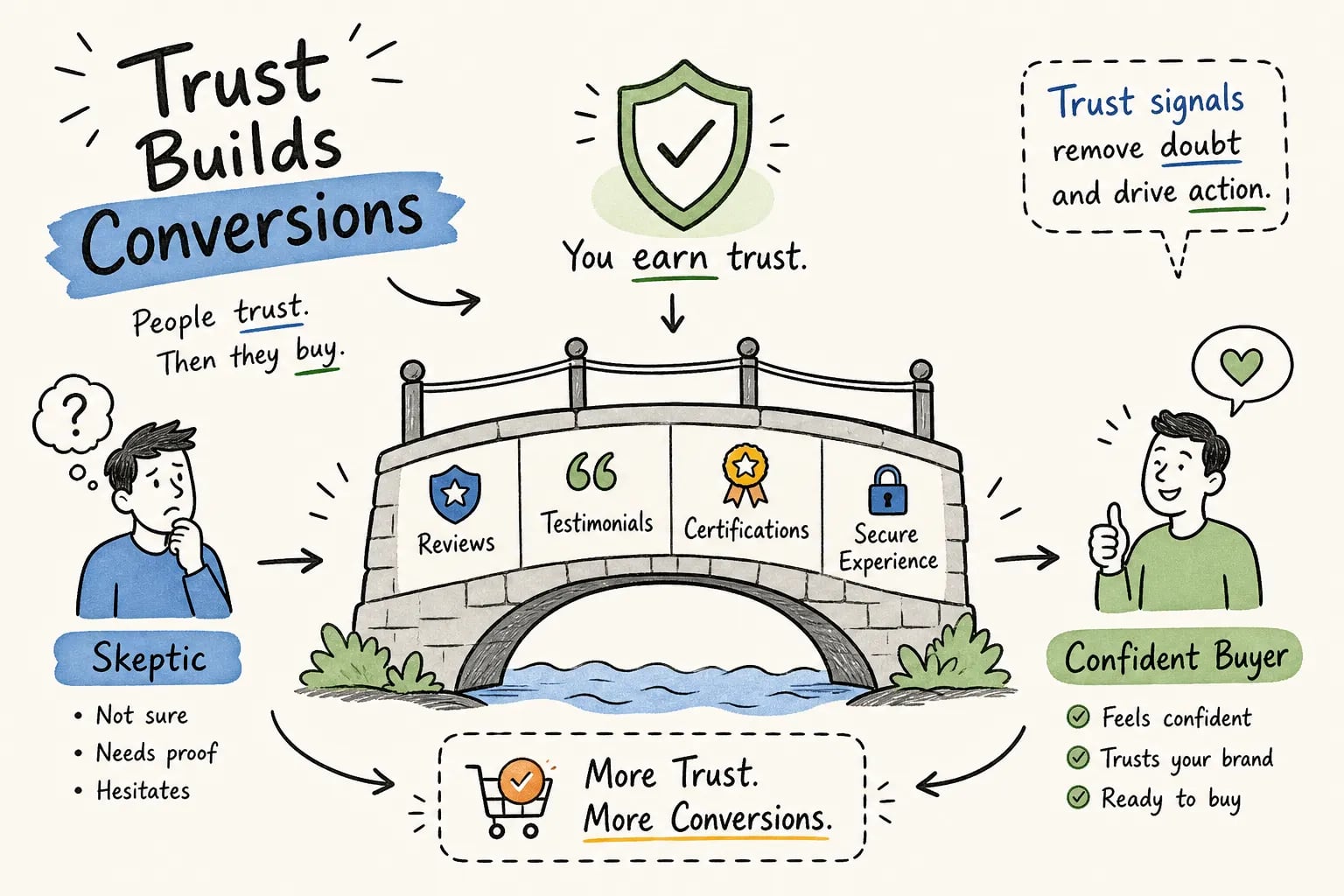
Trust signal marketing is the deliberate practice of matching credibility signals to specific buyer anxieties across the full purchase journey. That’s a different goal than adding a badge near a button and calling it done. Businesses that build this systematically tend to see consistent lift that scattered trust cues simply don’t produce. The difference is structure, not just presence, knowing which signals to use, where to place them, and how to verify they’re actually working.
By the end of this article, you’ll know which signals produce documented conversion lift, where to place them for maximum impact, and how to run clean tests to measure whether they’re working.
What trust signal marketing actually means as a strategy
Most businesses treat trust signals as a checklist: add a badge here, drop a testimonial there, call it complete. That approach misses the point. A visitor on your homepage has different doubts than someone staring at your pricing page. Someone at the checkout form is at peak anxiety about risk. Trust signal marketing means mapping your credibility signals to the specific fears at each of those stages, not applying the same proof everywhere and hoping it lands.
The reason credibility signals work isn’t that they look professional. They work because they reduce perceived risk. Reviews reduce the fear of a bad purchase. Certifications reduce the fear of hiring an unqualified provider. Visible contact information reduces the fear that nobody will answer if something goes wrong. Understanding the fear behind each signal is what separates tactical trust-building from decoration. When you know what the visitor doubts, you know exactly which signal to show them and when.
The signals with the strongest documented conversion lift
Not all trust signals are equal. The ones with the clearest documented lift share a common trait: they’re specific and verifiable, not vague and generic. Social proof, authority markers, and named case studies each pull weight differently depending on where a visitor is in the decision process.
Social proof performs best when it’s attributed. Specific testimonials with a photo, name, and company deliver roughly 22% higher conversion lift than generic quotes, based on patterns across multiple A/B testing datasets. Review counts consistently outperform star ratings alone, with documented lifts in the 12, 35% range depending on placement and context. Testimonials that reference measurable outcomes carry more weight than vague praise, and third-party platforms like Google Customer Reviews and Trustpilot function as neutral validators that visitors already recognize and know how to read. This is testimonial marketing at its most effective: attribution turns a quote into evidence.
Authority markers reduce hesitation for considered purchases, especially in service verticals where buyers can’t easily evaluate quality before they commit. A recognized client logo strip has shown up to 18% lift in A/B tests when the logos are brands visitors already know. Published content, a recognized book, or a track record of documented results signals competence in a way that a badge cannot replicate on its own.
Named case studies outperform generic testimonials by roughly 19, 20% on service pages. The specificity is the signal. A named company, a measurable result, and a clear context give the reader something to verify mentally. Mini case studies linked from a landing page function as a credibility bridge between the claim and the commitment, giving visitors a reason to believe before they act.
Where to place trust signals across your site
Placement matters as much as the signal itself. The practical rule is: broad proof on top, specific proof in the middle, risk reducers at the point of commitment.
On your homepage, the goal is baseline trust, not conversion trust. The strongest pattern is one high-credibility signal above or just below the hero, such as an aggregate review rating, a client logo bar, or a short attributed testimonial, followed by deeper proof further down the page. Overcrowding the hero with multiple trust badges produces the opposite effect. It reads as desperate rather than credible, and it pulls attention away from the message you actually need the visitor to absorb. Conversion optimization practitioners recommend capping homepage trust signals at 3, 5 total, with no more than 2, 3 in any single visual area.
On service pages and pricing pages, purchase anxiety peaks. Conversion trust signals placed near pricing, beside form fields, and next to your primary CTA convert far better than the same signals buried in a footer. Security seals and payment reassurance belong next to the commitment action. The homepage builds trust that the business is real; the service page builds trust that this specific offer is worth the risk.
How to test your trust signal marketing results
Gut feel is not a measurement strategy. Most businesses either skip testing entirely or run tests that mix too many variables to produce clear answers, which means they keep the signals that look right rather than the ones that actually lift conversions. The only reliable approach is to test one change at a time against a defined success metric.
Test one variable at a time: badge type versus no badge, testimonial placement above versus below the CTA, named case study versus generic quote. Run each test for at least two full business weeks to account for traffic variation, and define your success threshold before launch, not after. Conversion rate is the primary KPI for most trust-signal tests because it connects directly to the action the signal is meant to support.
For longer or multi-step funnels, micro-conversions tell the story before the final conversion rate does. Button clicks, form starts, and scroll depth show trust impact earlier in the process. Average order value matters in ecommerce tests because a stronger trust signal may also shift product selection upward. Bounce rate is the right metric when a trust signal sits in your hero section and the first problem is premature exit, not checkout abandonment. Match the KPI to where the signal lives in the funnel.
Building a trust signal system instead of a patchwork
Most trust signal efforts underperform because businesses add them reactively, in response to a dropped conversion rate or a negative review. The result is inconsistent placement, outdated signals, and proof that doesn’t address what visitors actually doubt. A credibility badge from a certification you earned three years ago, placed on a page where visitors are worried about whether you handle their specific type of project, doesn’t move the needle.
A systematic approach starts with an audit of your actual trust gaps: where are visitors dropping off, what doubts exist at each stage, and which signals are absent or misaligned. TW3 Marketing’s Reputation & Conversion Optimization service is built on exactly this model. Rather than recommending badge placement generically, the process starts with the TW3 Marketing Authority Audit™, a structured review that scores trust and authority signals across your digital presence, identifies the specific gaps causing conversion loss, and matches signals to where visitors are actually hesitating. The outcome is a credibility presence that works across the full buyer journey, not just at one touchpoint.
The compounding return on structured credibility
Trust signal marketing earns its place because it compounds. Every review you earn and every named case study you publish makes the next visitor slightly more likely to act. Ads drive traffic; trust infrastructure converts it. Those are two separate jobs, and confusing them is why businesses keep spending more on acquisition without seeing proportional gains in revenue.
The businesses that build their credibility system deliberately will convert more from the same traffic because the trust signals do the convincing that no ad can do on its own. If you’re not sure where your gaps are, start with an honest audit of what a first-time visitor sees at your most important decision points. For a more structured look, reach out to the TW3 Marketing team, they’ll show you exactly how your authority signals score and where to focus first to get the most lift from your trust signal marketing investment.
