
Local service business owners are watching cost-per-click climb steadily while the leads they generate get thinner and less loyal. The moment you pause the campaign, the phone goes quiet. That’s not a marketing strategy. It’s a lease. If you’re looking for paid ads alternatives that actually hold their value over time, you’re asking the right question.
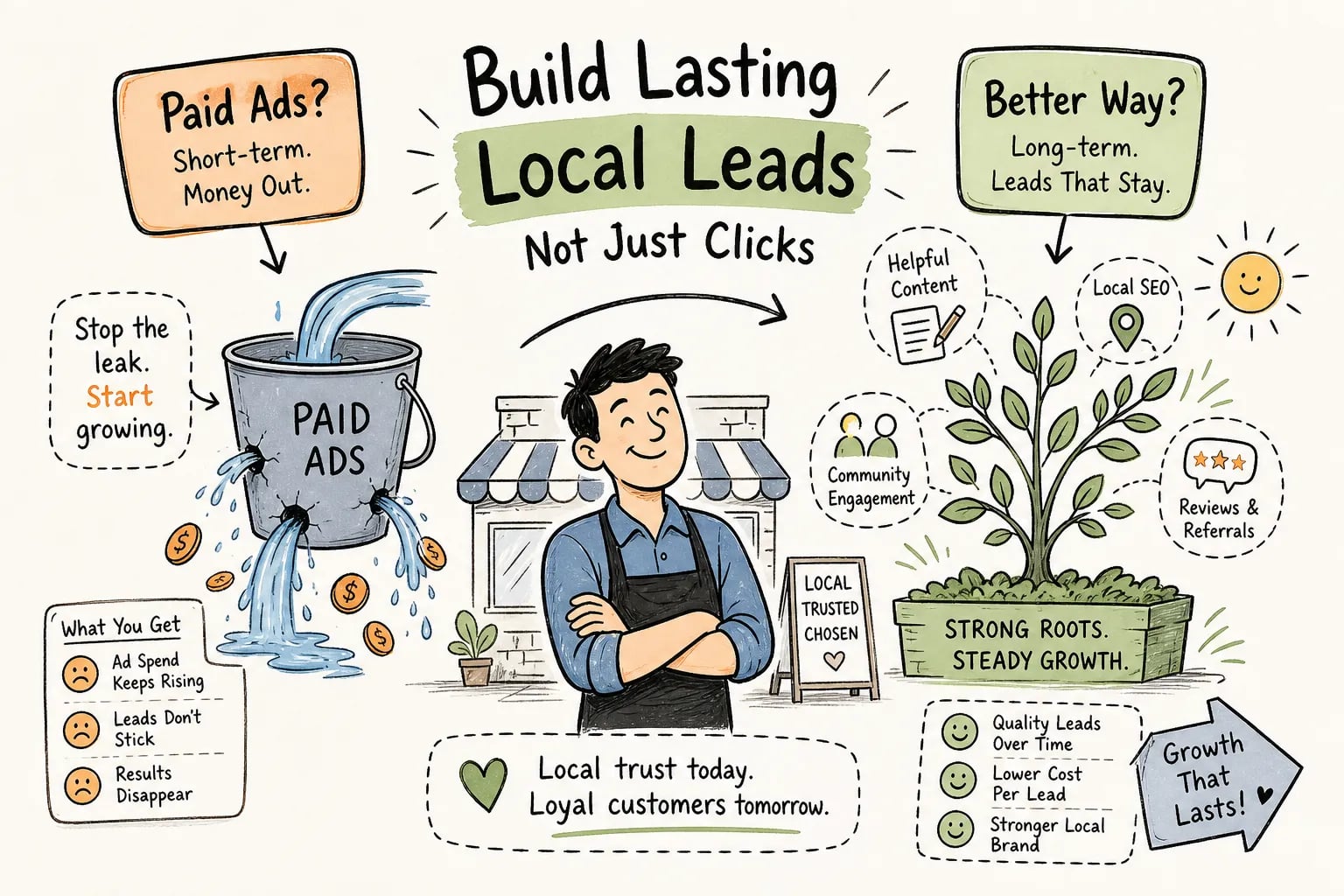
In 2026, with AI assistants reshaping how buyers find and evaluate service providers, there’s a more durable way to generate leads. TW3 Marketing’s recommended approach is what we call an authority-first model: building credibility signals that work across both traditional search and AI-powered recommendations, 24 hours a day, without a media budget running in the background.
What you’re actually buying when you run paid ads
Paid ads deliver traffic, not trust. For a local service business competing on expertise, reputation, and relationships, that’s a fundamental mismatch. You’re paying to be seen, not to be believed.
The ROI math keeps getting harder. Real estate leads average $102 from Google Ads. Insurance leads run $100 to $160. Those costs trend upward year over year as aggregators and national chains outbid local providers who can’t match their media budgets. You’re not just renting attention. You’re renting it in an increasingly competitive auction.
Alternatives to paid ads aren’t free, but they work differently. Organic channels require time and consistency upfront. What they return is compounding. The leads don’t stop when the budget does.
Paid ads alternatives: the organic channels that actually hold up
Not every alternative channel fits every business. Here’s an honest look at the ones with real staying power for professional service firms and local service businesses, these are low-cost marketing channels that build equity rather than burn budget.
Authority content and AI search optimization
Publishing expert content that answers the questions your best clients are already asking is the foundation of any organic growth strategy. In 2026, that means optimizing for how AI assistants like ChatGPT and Google’s AI Overviews pull and cite sources, not just for traditional page rankings. According to recent industry research, AI Overviews now appear on an estimated 68% of local searches. Businesses that answer questions clearly and consistently are the ones getting cited and recommended. Those that don’t are far less likely to appear in AI Overviews or get recommended by assistants at all.
Reputation systems and reviews
Reviews are trust signals, not vanity metrics. A service business with a strong volume of detailed, recent reviews on Google and relevant industry platforms carries more credibility with a skeptical buyer than any ad placement. Research consistently shows that higher review volume and recency improve both buyer trust and AI assistant visibility. Structured review requests, thoughtful response protocols, and visible case studies are the components of a working reputation system. Reviews and Google Business Profile completeness are also direct signals that AI assistants use when deciding which businesses to surface.
Referral programs and local partnerships
Referrals convert at three to five times the rate of paid search leads. In professional services, referred leads often close at 25% to 50%, compared to 5% to 20% for paid search traffic. A formal referral system turns satisfied clients into a consistent pipeline. Partnerships with adjacent professionals, accountants, attorneys, and financial advisors, create reciprocal referral channels that require no ad spend and no auction. This is non-paid customer acquisition at its most efficient.
Honest timelines: what each channel actually costs
None of these paid media alternatives are free. Content requires strategy, writing, and distribution. Referral systems require follow-up and incentive design. Reputation management requires consistency. The cost is mostly time and expertise rather than media spend, but the economics improve over time instead of deteriorating.
Here’s a realistic picture by channel:
- Content and local SEO: early movement in 2 to 4 months; meaningful inbound leads in 3 to 6 months; compounding results by 6 to 12 months. Monthly cost typically runs $1,500 to $5,000 for a focused local campaign.
- Review and reputation systems: visible impact within weeks once a cadence is in place. The main investment is process, not budget.
- Referral programs: first leads in 30 to 60 days if existing client relationships are strong. Setup cost is low; the main requirement is consistent follow-through.
- Local partnerships: first referrals typically within 60 to 90 days, with a repeatable pipeline forming at the 3 to 6 month mark.
Compare that to paid search, where leads in competitive local categories average $53 to $102 or more and results stop the moment you stop spending. The channel that takes longer to start is often the one that keeps working longest.
Why authority signals compound where paid ads can’t
Every piece of expert content, every review, every professional citation, and every clearly positioned service page builds a credibility layer that both search engines and AI assistants read. Unlike a paid impression, these signals stay. They accumulate.
A business that builds real authority signals in 2026 will still benefit from them in 2028. That’s not how ad spend works. These are ad network alternatives in the truest sense, you’re building an asset, not renting a slot.
The businesses that benefit most are the ones that connect authority to a functioning lead system. Visibility without follow-up wastes attention. The goal is a connected path from initial discovery through trust verification to a qualified sales conversation, solid content, credible proof, and a reliable pipeline to capture and convert interest.
TW3 Marketing works with established professional firms and service businesses to identify where authority gaps are costing them qualified inbound leads. Before recommending any channel or tactic, we clarify what’s missing and what to fix first. That distinction separates random marketing activity from a system that compounds.
Where to start this quarter
Before picking a channel, answer one question honestly: does your current web presence clearly communicate who you serve, what makes you different, and why a buyer should trust you before they ever contact you? If the answer is no, no paid ads alternative will perform at its potential. You’re sending curious buyers to an unconvincing destination.
Start with the basics this week. Audit your Google Business Profile, review volume, and website positioning. Send a structured review request to your last ten satisfied clients. Identify one referral partner and have a direct conversation. Begin answering one high-value client question per month in writing. These are the foundational moves that give every other channel something to build from.
The difference between equity and expense
Alternatives to paid advertising aren’t about avoiding all investment. They’re about investing in things that build equity instead of evaporating when you pause.
The most effective paid ads alternatives for local service businesses in 2026, authority content, AI visibility, reputation systems, referrals, and partnerships, share one characteristic: they compound. Each one makes the next lead easier to earn.
If you’re not sure where your authority stands, the TW3 Marketing Authority Audit™ gives you a clear, evidence-based picture of your gaps and a prioritized roadmap before you commit budget to any channel. That diagnostic step is what separates a real strategy from an educated guess. Start with the audit. It tells you exactly where you stand.
