
So how do professional service firms build authority online? It’s a question worth asking directly, because the answer isn’t more content or a redesigned website. It’s a connected system, and most firms are missing at least half of it.
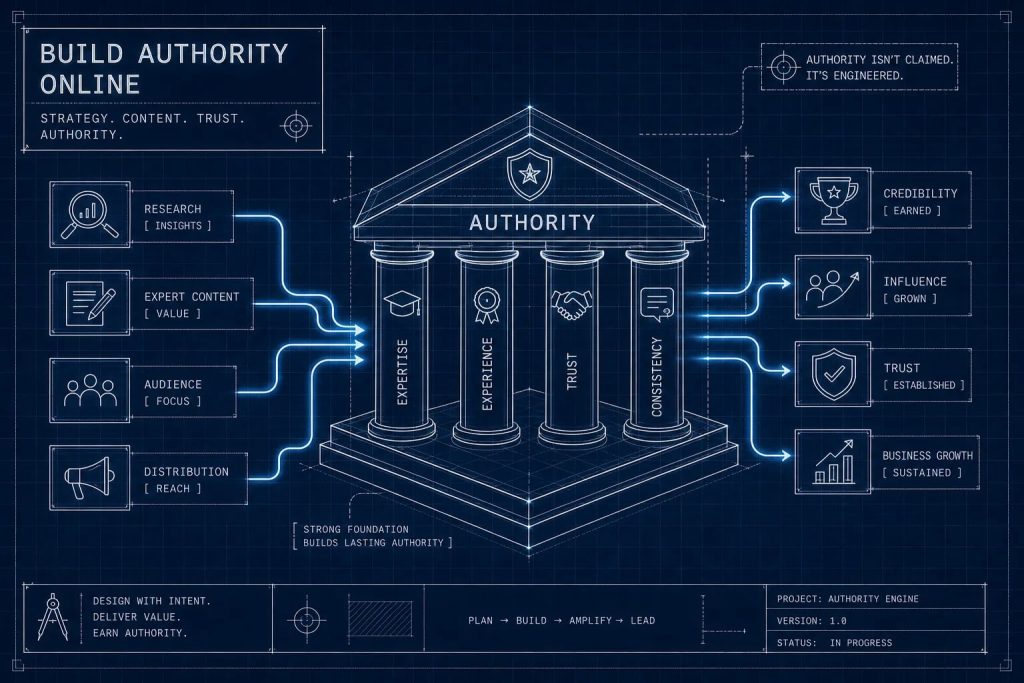
Many established professional firms possess deep expertise. The problem is that expertise doesn’t automatically become visible, credible, or findable to buyers who’ve never met you. That gap isn’t a marketing problem in the traditional sense. It’s an architecture problem.
Buyers researching consultants, CPAs, attorneys, and advisors are making high-stakes decisions. They’re not just looking for capability. They’re looking for evidence that you’re the right fit for their specific situation. Generic credentials don’t give them that. A well-structured authority marketing system does.
That system covers six areas: positioning, proof, expertise, visibility, engagement, and client experience. Work through them in order, the results compound. Skip the foundation and the tactics built on top of it will underperform no matter how much you invest.
How Professional Service Firms Build Authority Online: Positioning First
Before publishing a single article or collecting another review, a firm needs a clear answer to one question: why should a specific buyer choose you over anyone else? Most professional service websites answer that with vague capability statements. “Trusted advisors.” “Full-service solutions.” “Committed to results.” These phrases say nothing buyers can act on.
Specialization is the most underused lever in professional services. A firm that works specifically with mid-market manufacturing companies on operational compliance carries far more buying confidence than one that “serves businesses of all sizes.” The clearer the specialization, the faster buyers recognize fit, and the less selling the firm has to do afterward.
Strong positioning follows a simple structure: who you help, what problem you solve, and what’s different about how you solve it. That clarity needs to appear on every service page, every bio, and every piece of content the firm publishes. Inconsistency here creates friction exactly where you don’t want it.
How to Build Authority Online, Thought Leadership That Proves Expertise
There’s a meaningful difference between content that talks about expertise and content that demonstrates it. Most firm blogs fall into the first category. They describe services, summarize industry trends, or repeat advice buyers can find anywhere. That content blends into the background.
Practitioner-led content does something different. When a named principal writes with specificity about a real client challenge, the methodology used, and the measurable outcome achieved, it functions as evidence. Firms that publish industry-specific white papers on a consistent cadence have documented meaningful increases in inbound enterprise leads, sometimes north of 30% within a year. The mechanism isn’t mysterious: original data, first-hand methodology, and documented outcomes give buyers something concrete to evaluate.
Practitioner Bylines
Bylines matter. Content attributed to a named expert with verifiable credentials carries more weight than content posted under a generic firm account. Pair the author’s name with a short bio, a link to their professional profile, and their area of specialization. That combination signals credibility to both human readers and search systems.
Case Study Structure That Converts
A detailed case study with a real result does significantly more authority work than multiple generic articles about industry trends. A strong case study names the client type, describes the specific problem, walks through the approach, and states a measurable outcome. Start with proof, then distribute the ideas. Turn research and case-study lessons into practical articles that answer specific buyer questions. Connect those articles to deeper assets. Build a content system, not a content calendar.
Website Trust Signals That Move Visitors Toward a Conversation
The highest-converting trust signals on professional service websites share three qualities: they’re specific, relevant, and independently verifiable. Named expert bios with credentials, years of experience, and links to professional profiles carry significantly more weight than a logo wall or an unexplained “award-winning” badge. Buyers in legal, financial, and advisory services are verifying the humans before they make contact, that behavior is well-documented in research on how professional buyers evaluate service providers.
Placement matters as much as the content itself. A strong case study buried in a portfolio section nobody visits doesn’t convert. That same case study embedded directly on the relevant service page, beside the call to action, does. Put the proof next to the moment of decision. Attributed testimonials that name the client, describe the problem, and state the outcome consistently outperform anonymous praise, the specificity is what makes them believable.
Search and AI Visibility Through E-E-A-T and Structured Content
Search engines and AI systems increasingly reward content that demonstrates first-hand experience, credible attribution, and direct answers to specific questions. For professional service firms, that means organizing service pages around what buyers actually ask: who this is for, what the process involves, what outcomes to expect, and what happens next. Content structured this way is more likely to surface in AI-generated responses, not just traditional search results. This approach is sometimes called AEO, or answer engine optimization for professional services, and it’s becoming a meaningful part of how firms build authority online.
Schema markup, including Organization, Person, Service, and FAQPage types, helps search systems interpret and classify a firm’s expertise. But schema is a semantic aid, not a shortcut. It amplifies credible content; it cannot compensate for weak evidence.
Firms should establish entity consistency first. Confirm that your name, credentials, and expert profiles match across the website, professional directories, and association listings. Then layer in structured data. Getting that sequence wrong is a common and costly mistake.
FAQ: Common Questions About Building Authority Online for Professional Firms
How long does it take for professional service firms to build authority online?
Most firms begin to see measurable traction in search and AI visibility within three to six months of consistent, structured effort, assuming positioning is clear and content is practitioner-led from the start.
What’s the difference between authority marketing and general content marketing?
Authority marketing is built on verified proof: named experts, documented outcomes, and consistent entity signals across the web. General content marketing often focuses on volume and topics. Authority marketing focuses on credibility and specificity.
Do professional service firms need to be on social media to build authority online?
Not necessarily everywhere. Firms build authority faster by being consistently visible on the two or three platforms where their buyers actually spend time, typically LinkedIn for B2B professional services, rather than spreading effort thin across channels.
Is a website redesign necessary to build authority online?
Rarely the first step. Most firms have more to gain from fixing their positioning, adding credible trust signals, and restructuring existing content than from a full redesign. Evaluate first, then build.
Find Your Authority Gaps Before Taking Action
Most firms jump to tactics before they understand where they actually stand. Executing a content calendar or launching a new website without knowing whether your positioning is clear, your proof is credible, or your site answers buyer questions is expensive guesswork. The TW3 Marketing Authority Framework evaluates six dimensions, positioning, proof, expertise, visibility, engagement, and client experience, to identify which gaps are actually limiting growth and which tactics to prioritize first.
The TW3 Marketing Authority Audit™ produces a 100-point Authority Score, identifies evidence-based gaps, and delivers a prioritized roadmap before any implementation begins. For firms ready to invest in a sustained program, knowing where you stand removes the guesswork.
A free Authority Level assessment is also available if you want to see where your firm fits before committing to a full diagnostic.
Before You Build More, Evaluate What’s Already There
How do professional service firms build authority online? The same way they build it in person: through demonstrated expertise, verifiable proof, and consistent visibility where buyers are looking. The difference is structure. Firms that treat positioning, content, trust signals, and AI visibility as a connected authority marketing system see results that compound over time. Firms that treat them as separate tasks see inconsistent returns, and can’t diagnose why.
Before adding more tactics to the pile, take an honest look at what’s working and what’s undermining it. If you’re not sure where to start, contact the TW3 Marketing team. That’s exactly what the diagnostic is for.
