
If you’re asking how do I get my business to show up in ChatGPT answers, the first thing to understand is that a website alone won’t do it. Many business owners assume their web presence is enough, and that assumption is costing them real visibility. When a potential client asks ChatGPT to recommend a consultant, insurance agent, or real estate professional in their area, the businesses that show up aren’t the ones with the flashiest sites. They’re the ones whose information is consistent, well-documented, and confirmed across multiple sources the AI can actually read and trust.
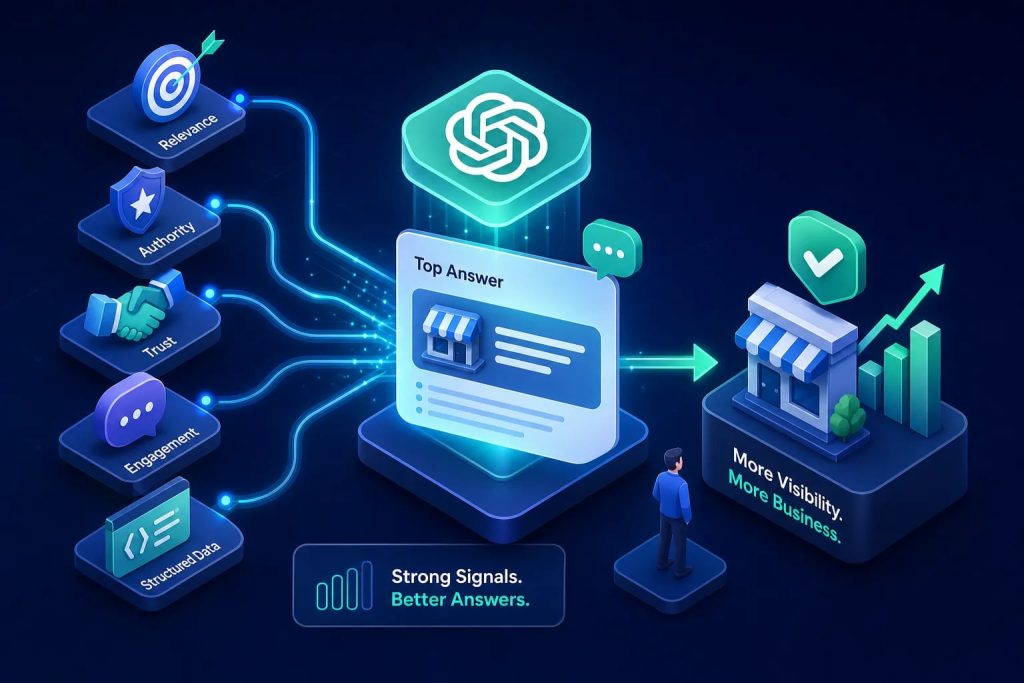
ChatGPT doesn’t rely solely on live Google searches to find your business. It combines pretraining knowledge with live retrieval from its own crawlers and partner search and data feeds, though OpenAI hasn’t published a definitive list of those providers. Your website contributes to that picture, but it’s only one piece. This guide focuses on the documented, practical signals you can control right now.
How ChatGPT decides which businesses to surface
Two layers are at work. The first is model knowledge: information the system learned during training from web content, directories, editorial coverage, and review data. This layer is useful but static. It can be outdated, and it doesn’t update automatically when you change your phone number or add a new service. The second layer is live retrieval: for location-specific and time-sensitive queries, ChatGPT actively pulls from search indexes, business feeds, maps, and partner data sources to generate current answers.
Underneath both layers is a mechanism called cross-source agreement. When multiple credible sources describe your business consistently, same name, services, location, and category, ChatGPT and similar AI systems treat that business as an established entity. When sources conflict or are sparse, the system loses confidence and may skip your business entirely in favor of a competitor with a cleaner data footprint. Getting recommended isn’t random. It’s a signal-matching process you can prepare for.
How do I get my business to show up in ChatGPT answers: the baseline signals
Before anything else, your NAP needs to be locked down. NAP stands for name, address, and phone number, but in practice it extends to service descriptions, hours, service area, and business category. Every mismatch across your website, Google Business Profile, Yelp, industry directories, and social profiles creates what’s called entity confusion. When an AI system can’t reconcile conflicting records, it may fragment your listing or suppress it entirely. Audit your listings for mismatches before implementing anything else.
Once your information is consistent, structured data becomes your next priority. Schema markup is code you add to your website that helps AI systems extract facts reliably without having to infer meaning from your prose. The four types that matter most for professional service businesses are Organization (brand identity), LocalBusiness (location and local services), FAQPage (direct question-and-answer pairs), and Service (what you actually offer). Structured data clarifies meaning; it doesn’t substitute for accurate, credible content. Both are required.
Checking your structured data
Use Google’s Rich Results Test or Schema.org’s validator to confirm your markup is error-free. Even well-intentioned schema can backfire if it mismatches the visible content on the page, AI systems and search engines both cross-reference the two. Run a quick validation any time you update your site’s core pages.
Third-party authority signals AI systems weigh heavily
AI systems tend to prioritize independent third-party coverage over self-published claims. That’s a principle worth internalizing before you spend more time polishing your About page. The sources that carry genuine credibility include industry publications, local and regional news, professional associations, established directories, relevant review platforms, and analyst or editorial comparisons. A bare-bones directory listing barely registers. A detailed writeup in a respected trade publication, one that explains your specialization and client fit, carries real weight with systems like ChatGPT and Perplexity.
Reviews deserve special attention because they provide natural-language descriptions of what your business is known for, which reinforces topical association across AI systems. Co-citations matter too: being mentioned alongside competitors, industry terms, or recognized organizations in comparison or “best of” content strengthens your topical relevance. Prioritize earning genuine reviews on the platforms your buyers actually use, then pursue editorial mentions in niche-specific publications.
This is where authority development work gets specific. At TW3 Marketing, building an AI-ready authority profile for a professional firm starts with identifying exactly where that firm is missing from the sources AI draws on, then closing those gaps layer by layer. The goal isn’t volume of mentions; it’s presence in the right sources.
Expertise content structured so AI can cite it
AI systems retrieve self-contained blocks of content. Long, unbroken narrative is harder to extract than structured answers under descriptive headings. Question-based H2 and H3 headings work well: lead with a concise direct answer, then follow with supporting evidence and context. Source your topics from real buyer questions pulled from sales calls, reviews, forums, and search data. If buyers are asking it, it belongs on your site in an extractable format.
What makes content citable
Generic service-page copy makes a business look interchangeable. Original proof is what earns citations: case studies, client outcomes, proprietary benchmarks, named authors with verifiable credentials, and transparent methodology. Include publish dates and update dates on high-value pages, freshness matters for time-sensitive answers. Content that a human expert can clearly stand behind is what AI systems surface. Content that could have been written by anyone rarely makes the cut.
Auditing and tracking your AI visibility
Build a list of 10 to 20 realistic prompts a potential buyer might use when searching your category, location, and services. Run them across ChatGPT, Perplexity, and Google AI Overviews. Visibility can vary significantly by platform, so testing one system isn’t enough. For each prompt, note whether your business appears, what position it holds, whether it’s recommended or just listed, and which sources are cited.
Repeat the audit monthly. Track changes after you update content, add schema, or earn new third-party mentions. If ChatGPT describes your business incorrectly, conflicting information in your public listings is often the culprit, though stale indexed pages and crawlability issues can also play a role. Fix the source data, not the symptom. AI visibility is a trailing indicator of your overall authority profile. Improving the profile is the sustainable path; trying to game individual outputs isn’t.
Start with the gaps, not the tactics
When business owners ask how do I get my business to show up in ChatGPT answers, they’re usually expecting a quick technical fix. The real answer is less exciting but more durable: build a consistent, well-documented authority profile that AI systems can read, verify, and confidently recommend. The businesses getting recommended aren’t necessarily the best in their market. They’re the ones whose expertise, credibility, and consistency are clearest across the sources AI draws from, a practice increasingly referred to as Answer Engine Optimization (AEO).
Start by understanding where your authority profile has gaps. You can work through that audit yourself using the framework above, or bring in a firm that specializes in building these systems for professional service businesses. Either way, the audit comes before the implementation. Skipping it means investing time and budget in tactics that may not address the signals that actually matter for your specific situation, and that’s the mistake worth avoiding if you’re serious about showing up in ChatGPT answers.
