
What does an authority audit reveal about why a service business isn’t getting more leads? More often than not, it reveals a trust problem, not a traffic problem. Many service business owners are watching solid work go out the door while lower-quality leads trickle in. The phone rings less than it should. Referrals carry the business while every other channel feels flat.
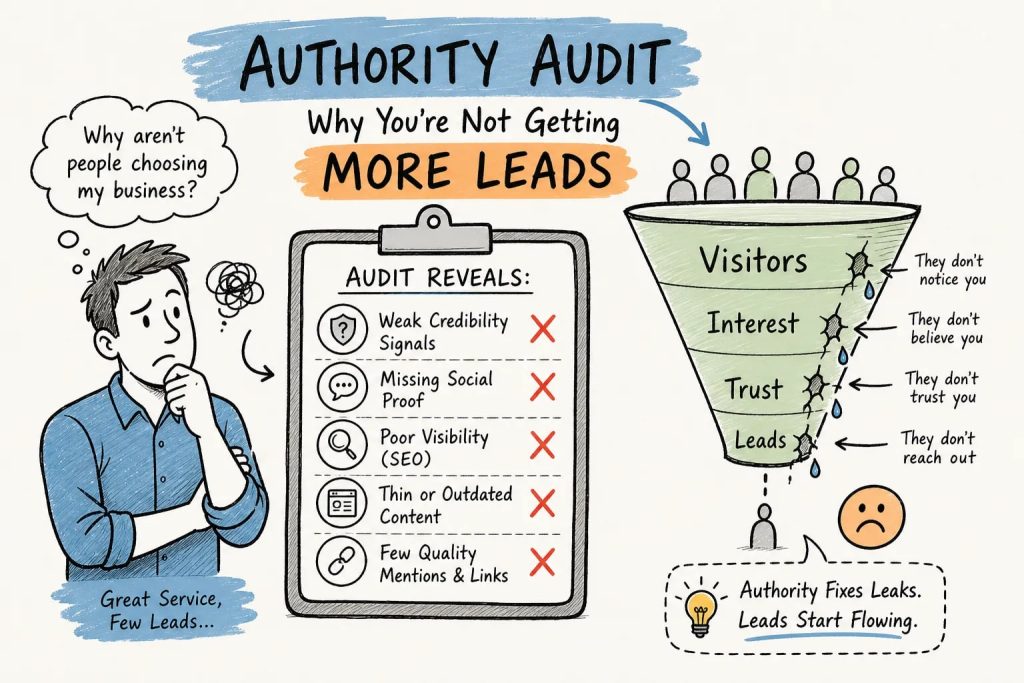
The frustrating part is that most advice treats the symptom: post more content, run ads, get more reviews. None of it addresses what’s actually broken. That’s what a structured authority audit is for. The TW3 Marketing Authority Audit™ runs a comprehensive diagnostic across six dimensions that determine whether a prospect, a search engine, or an AI tool sees a business as credible and worth contacting. The same gaps show up across different industries, different markets, and different firm sizes. Here’s exactly what those gaps are and what to do about them.
Why lead generation problems are harder to diagnose than they look
Most owners can describe what’s wrong: fewer inquiries, lower-quality leads, prospects who ghost after the first conversation. What they can’t describe is why. Without a structured diagnostic, every guess leads to a new experiment with no baseline to measure against.
Posting more content, pushing for more reviews, or redesigning the website in isolation rarely moves the needle. The issue isn’t the individual tactic. It’s that these efforts are disconnected from a clear picture of where authority is actually breaking down in the buyer’s decision process. You can’t fix what you haven’t measured.
What a thorough authority audit actually examines
The six dimensions driving buyer trust
A complete brand authority assessment evaluates six dimensions: positioning, proof, expertise, visibility, engagement, and experience. Each connects to how prospects find a business, decide it’s credible, and take the step to reach out. Auditing only one or two of these dimensions gives a partial picture and leads to incomplete recommendations.
The specific metrics examined include keyword rankings, branded search volume, referring domains, review volume and recency, case-study visibility, AI entity consistency, page-level conversion rates, and form-completion data. These aren’t vanity metrics. They’re the leading indicators that tell you whether the business is building authority or losing ground before the first conversation even starts.
What an authority audit reveals about trust and lead loss
Authority audit findings consistently show a pattern: businesses that score poorly across multiple dimensions don’t just rank lower, they lose leads at every stage of the buyer journey. A business that looks credible in search but thin on proof loses the visitor after the first click. One with strong proof but weak AI entity data gets skipped entirely in AI-generated recommendation responses.
The gaps that almost always surface
The most common finding across audits is that a business hasn’t clearly defined who it serves best, what makes it different, or why that difference matters to the right buyer. The website makes broad claims without the specificity that earns trust. Case studies are missing, generic, or buried where no one finds them. Named testimonials with measurable outcomes are replaced by vague quotes that any competitor could use.
Search behavior has shifted in ways that compound this problem. Buyers are asking AI tools for recommendations, and those tools pull from structured, consistent, credible sources. Businesses with inconsistent entity information across their site, directories, and profiles get overlooked or misrepresented. Reviews make the problem worse: low volume, outdated ratings, and no visible response pattern signal lower trust to both AI systems and the humans reading them.
Even when a business has solid positioning and decent proof, technical problems can quietly suppress lead capture. Service pages that aren’t properly indexed don’t rank. Slow-loading pages lose visitors before the value proposition registers.
Forms that break on mobile, calls to action placed below the fold, and trust signals buried on a separate testimonials page all reduce conversion from the traffic that does arrive. A site has to be discoverable, fast, persuasive, and technically capable of recording and routing a lead. Many service websites fall short on at least two of those four, and the drop in leads that follows gets blamed on the market instead of the mechanics.
How each gap compounds the lead-flow problem
It’s rarely one issue. It’s a chain of friction. A weak positioning statement reduces click-through rates from search. Thin proof keeps visitors from converting after they arrive. Poor AI visibility means the business isn’t mentioned in conversations that happen before buyers ever visit a website. Each gap feeds the next, producing a steady reduction in both volume and quality of inbound inquiries.
The math makes this concrete. A 20% loss in qualified organic traffic combined with a 25% reduction in conversion rate from UX or trust issues doesn’t produce a 20% lead decline, it produces a 40% one. That’s the difference between a sustainable pipeline and a business that depends on referrals and personal hustle to stay full. Many owners attribute the decline to the market or competition. The real cause is a set of fixable authority gaps they haven’t diagnosed yet.
What a scored audit gives you that guessing doesn’t
Authority score analysis: quick wins versus long-term strategy
The TW3 Marketing Authority Audit™ produces a scored assessment across all six dimensions, a competitor comparison, and a prioritized roadmap that identifies which gaps have the highest impact on lead generation. Instead of a list of things that could be better, it shows which gaps are actively costing leads and in what order they should be addressed.
Some fixes produce results fast. Adding named case studies near a primary call to action, cleaning up directory inconsistencies, these kinds of high-leverage changes often move the needle within weeks. Others take sustained effort: building AI visibility, developing thought leadership content, and strengthening the backlink profile with relevant referring domains. The audit separates these clearly, giving the business a starting point it can act on immediately while building toward durable authority over time.
A conversion and UX audit for service businesses in practice
Consider a professional services firm with consistent referral traffic but a stagnant inbound pipeline. A full authority audit and UX review might reveal that the primary service page loads slowly on mobile, the call to action sits below three paragraphs of credentials, and no case studies appear until a buried third-level page. Fixing those three items alone, page speed, CTA placement, and proof visibility, can measurably improve conversion rates from existing traffic without spending a dollar on ads.
The bottom line: what an authority audit reveals
Many service businesses aren’t struggling because they do bad work. The more common reason is that the proof of their expertise isn’t visible where buyers look. The positioning doesn’t give prospects a clear reason to choose them over a competitor. The systems connecting authority to lead capture have gaps that aren’t obvious from the inside.
An authority audit makes the invisible visible. It turns a frustrating, hard-to-diagnose problem into a specific set of prioritized actions with a clear starting point. If you want to know exactly where your business stands, the TW3 Marketing Authority Audit™ delivers a scored gap analysis compared to competitors and a roadmap built around your actual situation, not a template, not a checklist, but a real diagnosis. Get your free Authority Level score at TW3 Marketing and see where the gaps are before committing to a full audit.
