
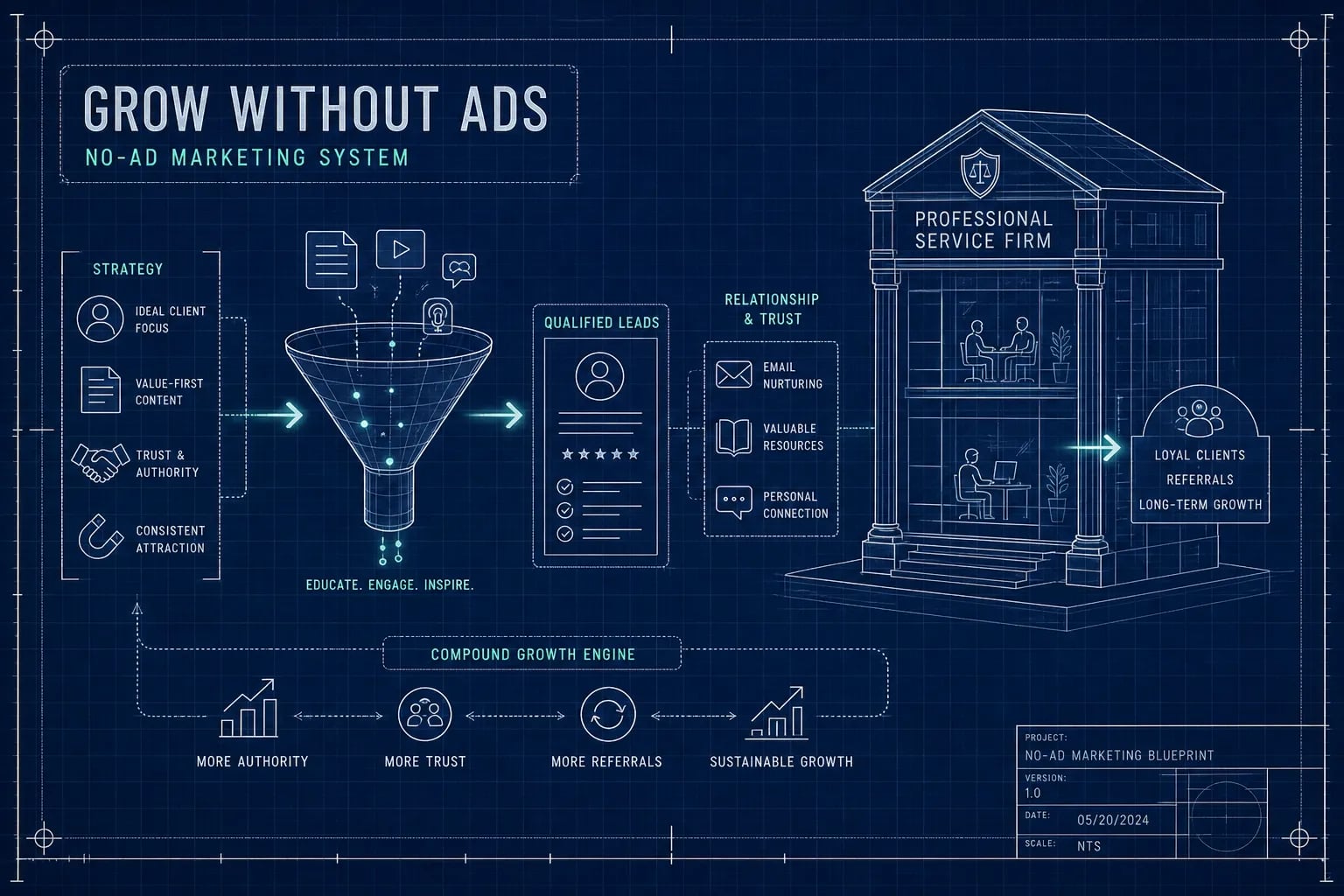
A no-ad marketing strategy for professional service firms means shifting your growth engine from rented attention to earned authority. Buyers find you through referrals, reputation, thought leadership, and AI search visibility rather than paid placements that stop working the moment you stop paying. Ads produce leads. For trust-based businesses, that is not the same thing as producing authority. Established firms that invest in building authority see compounding returns over time, not just transaction-level traffic that disappears when the budget does. This article is for firm owners with proven expertise who want sustainable, qualified growth through marketing without advertising, not a shortcut.
Key takeaways
- Ads versus authority: Paid ads generate traffic; authority generates trust. For professional firms, trust drives conversion, and ads cannot manufacture it.
- Referrals dominate: More than half of consultants report getting 60% of their business through referrals, according to Haus Advisors. Referred clients also convert 3 to 5 times faster than paid leads.
- Authority content builds AI visibility: AI assistants recommend firms with clear expertise signals, consistent presence, and independent corroboration. Generic positioning gets skipped.
- Reputation is infrastructure: Reviews, case studies, credentials, and media mentions are what buyers check before they contact you, and what AI systems check before they recommend you.
- Ninety days is enough to start: Month one is positioning; month two is building assets; month three is measuring what actually works. Full traction on content and organic channels typically takes longer.
No-Ad Marketing Strategy: Why Ads Are a Poor Fit for Professional Services Growth
The rented attention problem is straightforward. When you stop paying, the pipeline stops. That is not a growth model; it is a dependency. Referrals and content work differently: each satisfied client and each published piece of expertise builds on the last. Research shows referred customers can have 16 to 25% higher lifetime value than clients acquired through paid channels, according to Stealth Agents.
Professional service buyers do not work the way ad logic assumes. Someone hiring a consultant, an insurance advisor, or a real estate broker is not making an impulse decision. They research before they ever click anything, and by the time they reach out, the decision is mostly made. An ad can reach a buyer at the right moment, but it cannot make them trust you. Authority does that. Zero-budget marketing approaches, referrals, thought leadership, and reputation-building, work precisely because they participate in the research process rather than interrupting it.
What Authority Content Does That Ads Can’t Provide
Authority content answers the questions buyers are already asking: on Google, in AI tools like ChatGPT and Perplexity, and through professional networks. It earns your firm a place in the research process rather than cutting in front of it. The formats that work best for professional firms are specific: original research, evidence-rich case studies, named frameworks, executive-level articles, and webinars where prospects can observe how your senior people actually think and reason through problems. These are the building blocks of effective inbound marketing strategies for service firms.
How AI Assistants Factor Into Organic Customer Acquisition
AI assistants now surface businesses based on credibility signals, not keyword density. Studies on AI recommendation behavior, including analyses published by EpicNewMedia and spawned.com on how answer engines like Perplexity and ChatGPT select firms to cite, show these systems favor businesses that are easy to find, clearly described, independently validated, and directly relevant to the user’s specific problem. A firm with consistent positioning, specific service pages, and third-party corroboration gets mentioned. A firm without those signals gets skipped. Firms that establish clear AI-retrievability and corroborated expertise early may gain meaningful advantages as this channel matures.
How Referrals and Reputation Compound Over Time
Random word of mouth is not a strategy. A structured referral program is. More than half of consultants report receiving 60% of their business through referrals, according to Haus Advisors. Among real estate firms, 48% of sales volume comes from past-client referrals, per NAR research. These numbers reflect systems, not luck: identifying satisfied clients, making the referral ask consistent, and tracking where new clients actually originate.
Reputation signals are what buyers verify before they ever contact you. Reviews on Google and professional directories, case studies that document the client’s situation and measurable outcome, credentials, media mentions, and association memberships are trust infrastructure. They are also the same signals AI assistants use when deciding whether to recommend your firm. Building them is not vanity work. It is the foundation of a no-ad growth model, and it feeds both the buyer’s research process and the AI’s recommendation logic at the same time.
Building a 90-Day Plan and Knowing When to Get Structured Help
The framework is simpler than most firm owners expect. In month one, clarify your positioning and pick two to three channels: authority content, a referral program, and reputation development are a sound starting set. In month two, build the foundation assets: one strong content piece, a systematic referral ask process, and a review capture system. In month three, measure what’s working. The primary KPIs at this stage are where qualified leads came from and what each one cost in time and money, referral participation rate, qualified-lead rate, and client acquisition cost including labor are the numbers that tell the clearest story.
Implementing a No-Ad Marketing Strategy: Realistic Timelines
Be clear-eyed about what 90 days delivers. This framework is enough to start execution and produce early signals, press mentions, guest posts, referral inquiries, and initial content assets. Full traction on SEO and organic content channels typically takes 6 to 18 months, which is consistent with how content authority compounds. The 90-day plan starts the clock; it does not finish the race.
The honest constraint is that building authority is sustained work, not a one-time project. Most firm owners underinvest in implementation because they are running the firm at the same time. If that gap sounds familiar, TW3 Marketing’s Momentum and Domination programs are built for exactly that situation: established firms that want this strategy implemented and running, not just outlined on a whiteboard. Every engagement begins with the TW3 Marketing Authority Audit™, a 100-point assessment that identifies real gaps before any implementation is recommended. The work is based on evidence, not assumptions.
The Compound Returns of a No-Ad Approach
A no-ad marketing strategy is slower to start than paid ads and faster to compound once it’s running. Referrals, authority content, reputation signals, and AI visibility build your firm’s market position rather than just feeding its pipeline. These channels reinforce each other: a strong referral base reflects credibility, strong content earns AI mentions, and consistent reputation signals give buyers the confidence to reach out without hesitation.
This approach works for established firms that have something worth amplifying. If your expertise is real, your client relationships are strong, and you have the capacity to invest in sustained growth, a no-ad marketing strategy is not a constraint, it is a better model. When you are ready to find out exactly where your authority stands, reach out to our team and ask about the TW3 Marketing Authority Audit™.
Frequently Asked Questions
How should we measure progress in the first 90 days of a no-ad strategy?
Measure progress by tracking where qualified leads came from, what each one cost in time and money, referral participation rate, qualified-lead rate, and client acquisition cost including labor. These KPIs show which channels are producing early signals and help you decide what to scale or adjust after month three.
How do AI assistants decide which firms to recommend?
AI assistants surface businesses based on credibility signals like ease of discovery, clear descriptions, independent corroboration, and direct relevance to the user’s problem. Firms with consistent positioning, specific service pages, and third-party validation are more likely to be mentioned, while generic positioning gets skipped.
