
How service businesses generate leads without spending on Google Ads comes down to one thing: owning your pipeline instead of renting it. Paid ads work until they don’t. When you pause a campaign, incremental paid leads stop quickly, and unlike organic channels, paid traffic doesn’t keep compounding after the budget runs out. That’s not a lead generation system. It’s a rental agreement, and you’re paying month after month just to stay visible. Service businesses that build organic lead channels own their pipeline instead of leasing it.
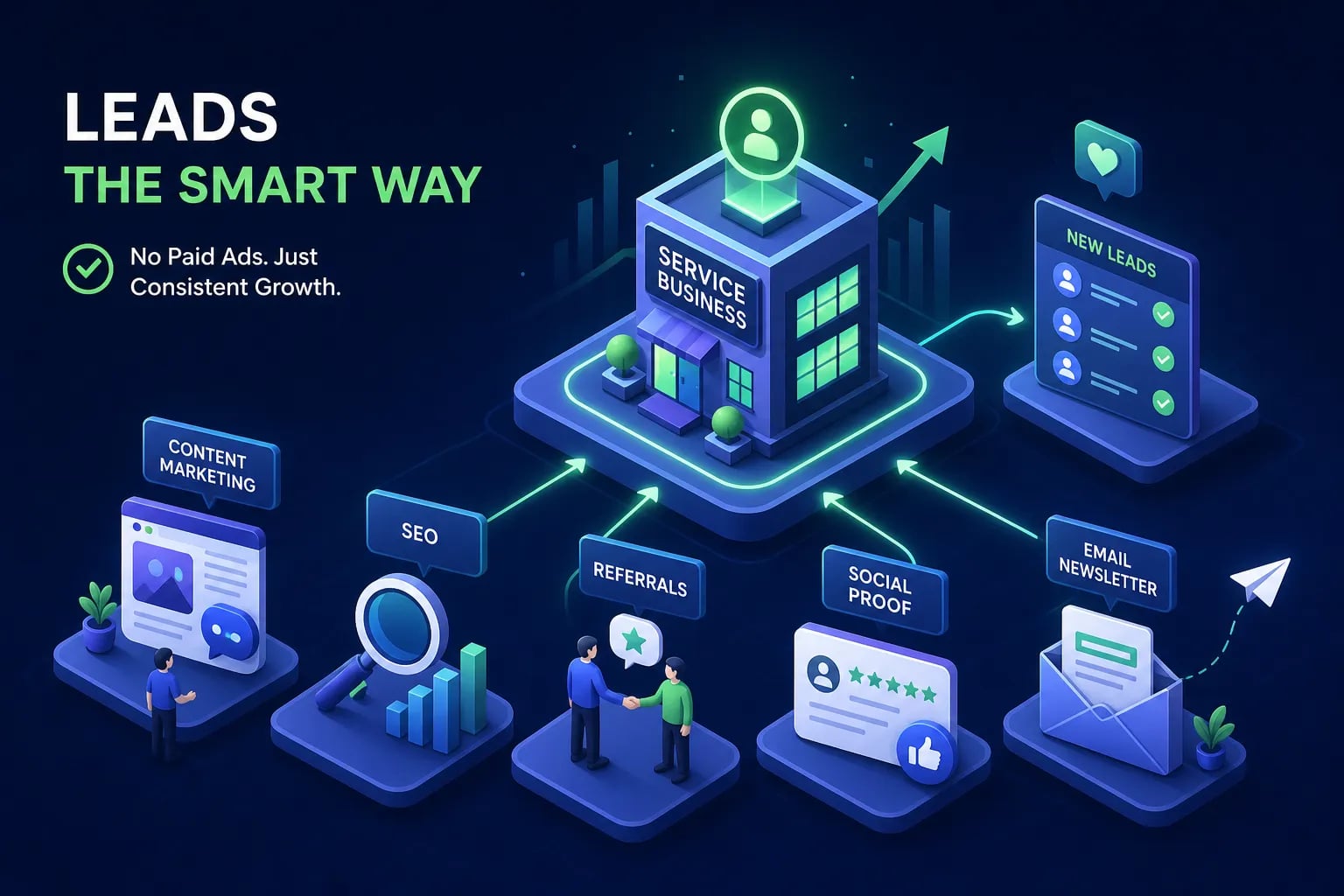
The non-paid channels that actually move the needle are Google Business Profile, referral systems, review optimization, content authority, and AI visibility. But before you build anything, there’s a step most service businesses skip, and it’s why so many organic efforts stall before they produce a single qualified call.
Figure Out Which Channel Fits Your Business Before You Build Anything
The most common mistake in organic lead generation is treating all channels as equal starting points. They aren’t. A solo consultant with five years of client relationships has different organic leverage than a 20-person firm with 300 Google reviews. Jumping to tactics before diagnosing your position is how businesses spend months producing content nobody reads while overlooking a referral system that could meaningfully lift their close rate in far less time.
The tendency is to copy what others are doing or pick the channel that feels most comfortable. The problem is that organic lead generation is earned based on your current authority signals: your reviews, your content footprint, your local presence, your reputation. Without a clear picture of where you actually stand, you’re guessing. A structured authority audit reveals your fastest path to inbound leads by mapping positioning, proof, visibility, and reputation gaps before recommending a channel priority. Think of it as a diagnostic before a prescription, the difference between a strategy and a template.
That’s the core of what the TW3 Marketing Authority Audit™ delivers for established service firms. Instead of a generic “do SEO and ask for referrals” checklist, you get a prioritized roadmap built around where your business already has credibility to leverage.
How Service Businesses Generate Leads Without Spending on Google Ads: Start With Your Google Business Profile
For most local service businesses, Google Business Profile (GBP) and local SEO are the top performers for both lead volume and buyer intent. These channels capture people already in-market, searching “HVAC repair near me” or “insurance agent in [city].” You’re not creating demand. You’re capturing it at the moment buyers are ready to act.
GBP Setup and Optimization
The baseline is a complete, verified profile with accurate hours, correct service areas, and consistent contact details everywhere your business appears online. The higher-impact moves are choosing the right primary category, uploading fresh photos regularly, and populating the Q&A section before buyers have to ask. Each of these reduces friction between a search and a phone call.
GBP Posts and Service Pages
Publishing regular posts with a clear call to action keeps your profile active and signals relevance to Google. Beyond your profile, dedicated service pages for each core offering and location-specific landing pages for your main service areas are the building blocks of local SEO. Unlike a Google post that expires, a well-optimized service page keeps capturing intent-driven traffic for months or years. That’s the compounding nature of local SEO: it builds equity instead of burning budget.
Referral Systems and Reviews Close at Rates Paid Traffic Can’t Match
Referral leads close at 30 to 50 percent in structured programs across many service categories. Cold paid traffic typically converts at substantially lower rates, often in the low single digits depending on channel and campaign quality. The reason is trust. A referred prospect arrives already believing you’re worth calling. Most service businesses get referrals passively. The ones growing intentionally build a system around it.
Timing is the biggest variable. In structured referral programs, asking within two hours of a completed service delivery consistently outperforms delayed follow-ups by a wide margin. The structure that converts best is a dual-sided offer: both the referrer and the new client get something. Keep the sharing mechanism to a single step, a direct link or a short text. Tie the ask to job completion so it happens automatically, not when someone remembers to follow up.
Reviews function the same way, just at scale. Quantity, recency, and sentiment all influence buyer decisions and AI recommendation systems. When someone asks ChatGPT or consults Google’s AI Overview for which service business to hire in their area, reviews are among the signals those systems use to evaluate credibility. A systematic review-request process built into your follow-up workflow turns satisfied clients into visible proof that compounds over time.
Content Authority and AI Visibility Create Durable Inbound Pull
Content is the slowest-building channel on this list. It’s also the one that creates the most durable inbound pull once it’s established. A well-positioned article, FAQ page, or expert guide answers the questions your ideal clients are already asking. When done correctly, those answers show up in both search results and AI-generated responses, organic search traffic and AI-generated referrals from a single piece of content.
AI tools like ChatGPT and Google’s AI Overviews tend to surface businesses and professionals with clear, well-organized, question-answering content indexed on credible websites. The format matters: direct answers to specific buyer questions, structured clearly, with enough supporting detail to demonstrate real expertise. This isn’t about keyword density. It’s about content a buyer could actually act on.
For professional service firms, thought leadership content does double duty. It feeds search and AI visibility, and it functions as trust-building material for prospects already in your pipeline who are deciding whether to move forward. The content you create for discovery is often the same content that closes the deal.
Local SEO: How Service Businesses Generate Leads Without Paid Search
Organic lead generation works, but it requires patience and measurement. Without tracking, you won’t know which channels are producing qualified conversations, meaning prospects who reach out ready to discuss a real need, and which ones are just keeping you busy.
Track these three: inbound contact rate by channel, so you know where leads are actually coming from; referral conversion rate, to measure how your post-service program is performing; and AI and search visibility, tracking whether your business name and content appear when buyers search high-intent queries in your category.
The goal isn’t to run all four channels at once. It’s to identify the one or two where your current authority gives you the fastest traction and build from there. If you’re serious about how service businesses generate leads without spending on Google Ads, that starts with knowing exactly where you stand. That’s exactly what the TW3 Marketing Authority Audit™ is built to show you, reach out to find out which organic channel deserves your attention first.
