
AI-driven search has quietly changed the front door to your business. Many buyers now consult ChatGPT, Perplexity, and Google’s AI Overviews for recommendations before they visit a website. The businesses showing up in those answers aren’t always the best ones. They’re the ones AI can verify, trust, and cite. If you’ve ever wondered how to know if your business’s digital authority is strong enough to compete in AI-driven search, you’re asking the right question, and this guide gives you a practical framework to find out.
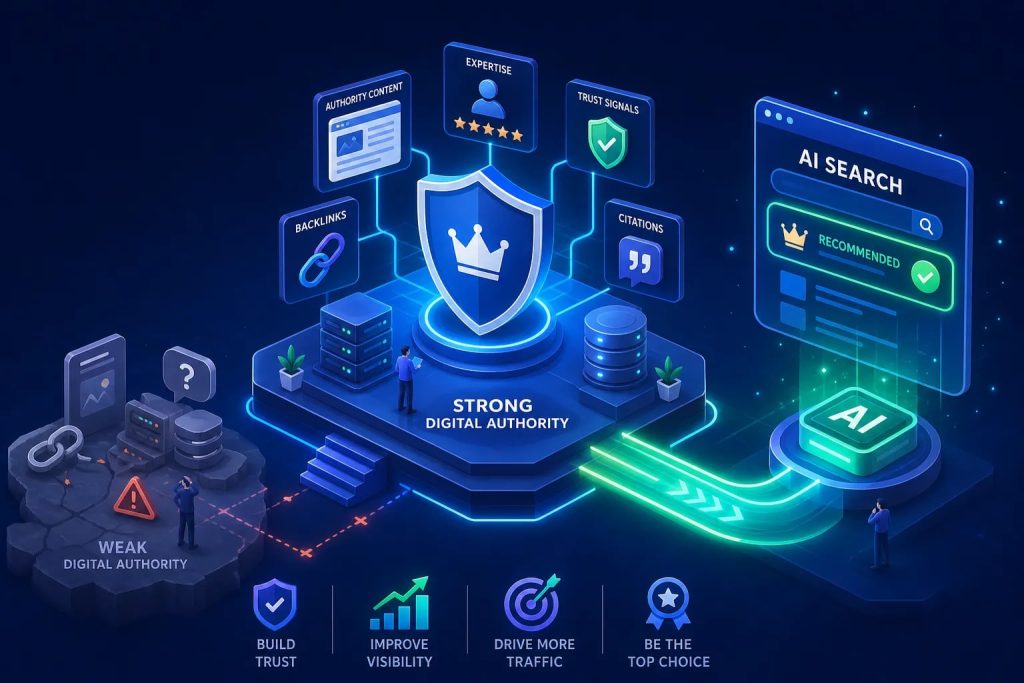
Most business owners assume they’re visible. They’ve done some SEO, collected a handful of reviews, and have a decent website. Assumption isn’t evidence. A 2026 analysis of more than 12,500 local businesses found that businesses appeared in only 8.24% of AI engine checks on category-related searches. That means the average business is invisible in roughly 92% of AI-generated answers. The gap between what owners assume and what AI systems actually surface is significant, and measurable.
What AI Answer Engines Look for When Selecting a Business
AI systems don’t rank pages the way traditional search does. They retrieve candidate businesses, then select the ones they can verify and attribute with confidence. Entity clarity and third-party corroboration are two especially important signals in that selection process, though AI systems also weigh query intent, topical authority, content freshness, technical accessibility, and overall brand salience.
Entity clarity means AI recognizes your business as a distinct, real-world entity with a consistent name, address, category, and attributes across your website, Google Business Profile, directories, and social profiles. If your business name is listed three different ways across platforms, that inconsistency erodes the system’s confidence.
Your own website can’t vouch for itself. AI systems look for independent validation: review platforms, industry publications, authoritative directories, media citations, and professional databases. These external signals confirm what your site claims. The principle behind this is what Google’s E-E-A-T framework formalizes, Experience, Expertise, Authoritativeness, and Trustworthiness, and AI answer engines apply similar logic when deciding which businesses to surface.
How to Check If Your Business’s Digital Authority Can Compete in AI-Driven Search
You can run a baseline audit using manual prompt testing. Open ChatGPT with web search enabled, Perplexity, Google Gemini, and Microsoft Copilot. For a reliable baseline, run 20 or more realistic customer queries across those platforms: “best [your category] in [your city],” “who offers [your service] for [your client type],” and “is [your business name] reputable?” Save each result along with the engine name, date, and exact prompt so the data is reproducible. Fewer prompts give you a rough directional sense; more prompts give you something you can act on with confidence.
Track four things for each prompt: whether your business is mentioned at all, whether it’s recommended or just listed, which source is cited (your website or a third party), and how competitors appear. Then calculate a simple mention rate: prompts that included your business divided by total prompts run. This baseline tells you where you actually stand. For most professional firms doing this exercise for the first time, the results are sobering.
Benchmarks That Define Strong Digital Authority for AI-Driven Search
There’s no single magic score, but there are competitive benchmarks worth measuring.
Reviews carry more weight than most owners expect. A rating below 4.5 is a visible weakness in AI-driven search. Volume matters too. Industry observers widely cite 100, 150 reviews per location as a credible baseline, with leading markets requiring significantly more. Review recency, detail, and platform diversity all contribute to how AI systems assess trust, sentiment and specificity factor in, not just the star rating.
On domain signals: compare your referring domain count and Domain Rating against your top three competitors using a tool like Ahrefs or Semrush. You want to be at or above the competitor median, not well below it. Check whether your business has a Google Knowledge Panel and verify it’s accurate. Branded search demand, meaning people actively searching your firm by name, is one of the strongest real-world indicators of authority. You can check it directly in Google Search Console. Growing branded query volume over the past 12 months is a strong positive signal.
A 10-Point Digital Authority Self-Assessment
Use this checklist to score your position across the signals AI platforms weight most heavily. Be honest. These gaps are fixable, but only if you can see them clearly.
- Entity consistency: Your business name, address, and phone number are identical across your website, Google Business Profile, and major directories.
- Knowledge Panel: A Google Knowledge Panel exists for your business and contains accurate, current information.
- Schema markup: Your site uses Organization or LocalBusiness schema with sameAs links to authoritative profiles.
- Named authorship: Key pages have a named author with a linked bio and verifiable credentials.
- FAQs and structured content: You have clear FAQ content that directly answers common client questions.
- Review baseline: You have 100-plus reviews across platforms, averaging 4.5 or higher, with responses from the business.
- Third-party mentions: Your business is cited in at least several independent, authoritative publications or industry directories.
- Referring domain competitiveness: Your referring domain count is at or above the median of your top three ranking competitors.
- Branded search presence: Google Search Console shows growing branded query volume over the past 12 months.
- AI mention rate: When you manually test 10-plus customer queries across AI platforms, your business appears in 30% or more of them.
As a rule of thumb, six or more gaps suggests your digital authority is weak relative to peers. That’s not a judgment. It’s a starting point, and competitive benchmarking against firms in your market will sharpen what that number actually means for you.
When Self-Assessment Isn’t Enough to Close the Gaps
Running this checklist tells you what’s missing. It doesn’t tell you which gaps cost you the most, or what to fix first. Not all authority gaps are equal. A weak referring-domain profile and an inconsistent entity may both show up on your checklist, but one might be costing you far more in AI visibility than the other. Without a structured diagnostic and competitive comparison, you’re improving by intuition rather than evidence.
If that’s where you are, a professional authority audit is worth considering before you invest time or money fixing the wrong things. TW3 Marketing Authority Audit™ is one option: a paid diagnostic that produces a structured Authority Score, identifies evidence-based gaps, benchmarks your position against competitors, and delivers a prioritized roadmap, so you’re working from data, not guesswork.
Know If Your Business’s Digital Authority Is Strong Enough, Then Act on It
Your digital authority is either working for you in AI-driven search, or it’s working against you by default. The self-assessment above takes most firms an hour or two to complete, depending on how many prompts and platforms you test. The results are more useful than any assumption you’ve been operating on.
Start with a free pass: check your entity consistency across three to five key directories, run a prompt test across four AI platforms, and pull your branded query trend from Google Search Console. Those three steps alone will tell you whether you have a problem worth solving. If the gaps you find are significant, don’t spend months addressing them without a clear priority order. AI search isn’t slowing down, and the firms showing up consistently in AI answers are building that position now. Get in touch with the TW3 Marketing team to start with a structured authority assessment before you invest another dollar in marketing that hasn’t been benchmarked against where AI-driven search visibility actually comes from.
